Illinois Prepares for Possible Iowa Lead Azide Detonation Fallout
Illinois officials said on November 23 that the U.S. Army’s planned detonation of about five tons of lead azide in Middletown, Iowa, is not expected to affect the state under current weather forecasts. The two controlled explosions are scheduled for November 25 at the Iowa Army Ammunition Plant, about four hours west of Chicago.
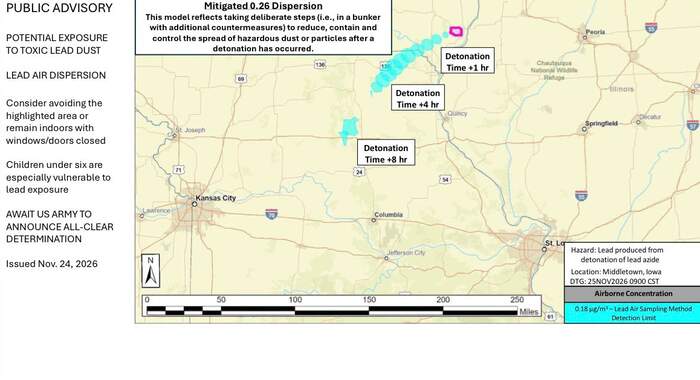
State environmental, health and emergency officials have created an online page to share updates, monitoring resources and precautions for residents, schools and child care facilities. NOAA’s latest model shows light winds from the east and northeast carrying the plume south and southwest, away from Illinois. The state says it is still seeking updated modeling and details from the Army about air-monitoring locations and timing.
Lead particles from the explosions could settle on outdoor surfaces if the plume reaches populated areas. Gov. JB Pritzker has put state agencies on alert and is pressing federal officials for more information. Sens. Dick Durbin and Tammy Duckworth have also sought answers, with Durbin calling for a public-health emergency team in Middletown. Army officials say the degraded stockpile could become more volatile as temperatures fall and argue that a controlled detonation is needed to prevent a more dangerous explosion. The Army moved the planned detonation to November 25 to take advantage of more favorable winds and allow additional safety measures.
Illinois Deserves Answers Before Army Blows Up Lead Azide
The Army is preparing to detonate about five tons of lead azide in Middletown, Iowa, on November 25, while Illinois officials say they still lack key details about federal monitoring and updated modeling. Illinois has launched a public website and put state agencies on alert, but residents should not have to rely on incomplete answers as a toxic-particle plume remains a concern.
NOAA’s latest model indicates winds would carry the plume south and southwest, not into Illinois. But state officials say they are still asking the Army for updated forecasts and specifics on where and how long air monitoring will take place. The Illinois EPA, health department and emergency-management office have gathered resources and safety guidance for residents, schools and child care facilities.
Gov. JB Pritzker is demanding transparency, while Sen. Dick Durbin has called for a public-health emergency team in Middletown and Sen. Tammy Duckworth has criticized the Army’s communication and planning. Army officials say the degraded stockpile may grow more volatile as temperatures fall and that inaction risks a more dangerous blast. That urgency does not excuse leaving families without clear information: officials should be able to explain the risks and show how they will protect people before proceeding.
Illinois Leaders Need Facts, Not Alarm, on Iowa Detonation
A dangerous stockpile of about five tons of degraded lead azide is scheduled for controlled detonation in Middletown, Iowa, on November 25. Illinois leaders are raising concerns, but the latest NOAA forecast points to light winds carrying the plume south and southwest, away from Illinois counties.
Illinois has launched a website with updates, monitoring links and precautions for residents, schools and child care facilities. State officials say they are seeking more information from the Army, including details on monitoring and updated modeling. Gov. JB Pritzker has placed state agencies on alert, while Sens. Dick Durbin and Tammy Duckworth have demanded answers and criticized the Army’s handling of public communication.
The Army says the stockpile could become more volatile as temperatures cool and that a controlled detonation is necessary to avoid a potentially more dangerous chain-reaction explosion. It moved the operation to November 25 for more favorable wind conditions and time for added safety measures. Public officials should press for the information needed to protect residents, but they should also communicate the current forecast clearly: it does not show an expected impact on Illinois.
Reported by CBS Chicago, FOX 5 New York, ClickOnDetroit WDIV.