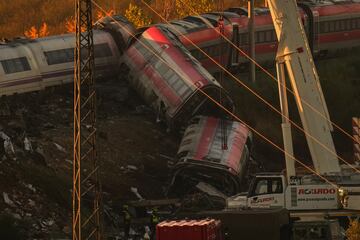
Spain’s transport minister resigns after second deadly rail crash
Puente announced he was leaving office after appearing for hours before lawmakers to discuss the October 28 collision south of Madrid. The crash killed 69 people and was the second deadly rail disaster in Spain in less than a year.
The collision happened when a high-speed train struck another train that had stopped on the tracks. A communications system linked to safety operations on the Madrid-Seville line had failed. Central controllers in Madrid then authorized a train to continue despite the stationary train ahead.
In January, another crash on the same line killed 46 people when a derailed train hit one traveling in the opposite direction. That incident remains under investigation. Puente said he had decided to resign immediately after the latest crash but had not announced it until now.
The minister said a transport chief could not stay in office after two such serious accidents in under a year. He also cited political dignity, consistency and empathy for victims. The crashes have prompted renewed concern about rail safety, with the latest coming four weeks before a national election.
Before announcing his resignation, Puente outlined government safety steps, including improving conditions in control centers and accelerating the introduction of a standardized European signaling and safety system. Spain’s high-speed network is the world’s second-largest, and had not had a deadly crash in more than three decades before this year.
After Two Deadly Crashes, Spain’s Transport Chief Steps Down
Two deadly rail disasters in one year have brought Spain’s transport minister to resign. Óscar Puente stepped down on November 3, six days after a collision south of Madrid killed 69 people and as the country faces renewed questions about railway safety.
The October 28 crash followed a failure in a communications system tied to safety operations on the Madrid-Seville line. Controllers in Madrid took over and authorized a train to proceed, although another train was stopped ahead. The January crash on the same route killed 46 people; it remains under investigation.
Puente said he had made his decision to resign just after the latest disaster. His departure recognizes that political leadership carries responsibility when public systems fail so catastrophically, even where direct responsibility for the events has not been established.
The government has announced plans to improve conditions in control centers and speed up the rollout of a standardized European rail safety and signaling system. Those measures matter, but the deaths and the timing of the resignation make clear that public confidence depends on more than promises. With a national election four weeks away, rail safety is an urgent test of whether officials can protect passengers.
Resignation Follows Rail Disasters as Spain Faces Safety Questions
Spain’s transport minister has stepped down after two deadly rail crashes in less than a year, leaving basic questions about the network’s safety in sharp focus. Óscar Puente announced his resignation on November 3, six days after a collision south of Madrid killed 69 people.
The latest crash came after a communications system connected to safety operations on the Madrid-Seville line failed. Controllers in Madrid authorized a train to continue even though another was stopped ahead. A January crash on the same line killed 46 people, and that incident is still under investigation.
Puente said he had decided to resign immediately after the October 28 disaster. His departure is an acknowledgment that the government must answer for the performance of a major public rail system. The causes of the January crash remain unresolved, making a thorough accounting of both incidents essential rather than treating resignation alone as a solution.
The government says it will improve control-center conditions and accelerate the adoption of a standardized European safety and signaling system. Those commitments now need to deliver safer operations. The crashes have shaken confidence in a network long regarded as a national achievement, and the latest disaster comes four weeks before a national election.
Reported by CNN, The Philadelphia Inquirer, WTOP, PBS NewsHour, Breitbart.