Army Plans Lead Azide Detonation as Plume Forecast Shifts Southwest
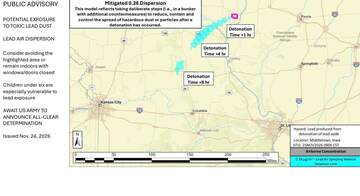
On November 25, the U.S. Army plans to detonate about five tons of degraded lead azide in two controlled blasts at the Army's ammunition facility in Middletown, Iowa. Updated forecasts show a plume of lead dust moving southwest, potentially reaching northeastern Missouri. The projected path and distance may change with weather conditions, including wind direction and speed and air movement at higher altitudes.
The Army says the material has become more sensitive to friction and shock after some water evaporated from its storage containers. Officials say moving it could trigger an explosion, and colder weather could increase the danger. They argue that destroying it in place under controlled conditions is safer than risking an accidental detonation.
FEMA has asked Middletown residents and people in nearby areas within a five-mile evacuation zone extending southwest of the plant to leave. Support including shelter, food, transportation and short-term lodging is available through November 27. People outside the zone have been advised to stay indoors, close windows and doors, and set heating and cooling systems to recirculate where safe.
The Army plans to revise its predictions for the dust plume six hours ahead of the blast, then every hour until the operation ends. EPA staff will monitor the air during the operation and sample affected areas afterward; people in the projected impact area can request sampling at their homes, schools or property.
The plan has faced opposition from residents, environmental groups and elected officials in both parties. Environmental groups sued over the EPA’s emergency permit, but an appeals court declined on Monday to block the operation. The Army says the detonation will use concrete, soil, sand barriers, water and mist to limit dust.
Lead Dust Risk Should Not Be Dismissed as Army Moves Ahead
The Army is moving ahead with a hazardous lead azide detonation near Middletown on November 25, even as the forecast shows toxic dust potentially crossing into northeastern Missouri. The plume’s path can shift with changing winds, leaving communities dependent on updated maps and monitoring while the operation proceeds.
Residents and environmental groups have raised concerns, and a bipartisan group of Iowa and Illinois officials sought a delay and safer alternatives. Sen. Tammy Duckworth called the rollout a “failure of leadership of epic proportions.” The challenge to the EPA’s emergency permit was not enough to stop the detonation, after an appeals court declined on Monday to block it.
The Army says the degraded material could explode if moved and that cold weather adds to the risk. But that rationale does not erase the public-health stakes: even minimal contact with lead can be harmful, and the projected airborne impact area is larger than the area expected to receive settled dust. Forecasts remain weather-dependent.
FEMA has told people in a five-mile zone southwest of the plant to evacuate, while others nearby have been instructed to shelter indoors. The Army must revise its plume predictions six hours ahead of the blast and every hour afterward until it ends. EPA personnel will monitor the air and collect samples, with residents in the impact area able to request testing.
Controlled Detonation Addresses Risk From Unstable Explosives
The Army is proceeding with a controlled detonation of roughly five tons of deteriorated lead azide at its Iowa military ammunition site on November 25, arguing that an uncontrolled explosion would pose the greater danger. Officials say the material has become more sensitive to friction and shock, and that moving it could set it off as winter approaches.
The operation is planned in place, with the barrels surrounded by concrete and soil, sand barriers, and measures to dampen dust. The Army says the controlled approach is safer than leaving unstable explosives in storage or attempting to move them.
The forecast plume currently points southwest toward northeastern Missouri, but officials stress that the modeled path can change with wind and other weather conditions. FEMA has asked residents in the nearby five-mile evacuation zone to leave, while people outside it should remain indoors during the plume’s passage. EPA staff will monitor air quality and collect samples after the detonation.
Environmental groups sued to challenge the EPA’s emergency permit, and elected officials from both parties urged a delay and alternatives. An appeals court declined on Monday to block the plan. The Army’s plume predictions will be revised six hours ahead of the operation and once per hour until it is complete, providing updated estimates as conditions develop.
Reported by The Daily Caller, Newsweek, CBS Detroit, The Guardian, CBS News, New York Post.