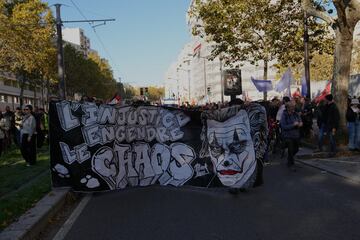
France Deploys 70,000 Police as Nationwide Protests Spread
France deployed 70,000 police officers on November 5 as strikes and demonstrations spread across the country. An official close to the interior minister said about 270,000 people had joined union action at 180 rallies outside Paris by November 5. The Eiffel Tower closed amid protests in the capital.
In Lyon, police released tear gas and rushed at demonstrators. Outside Toulouse, flames engulfed a secondary school. Authorities in Brittany said masked people tried to block roads in Rennes and that some threw steel balls at police. Officers were backed by armored vehicles, drones and helicopters.
Roughly one in three secondary schools in France could not open or function, with student blockades and teacher strikes among the reasons. The U.S. Embassy had warned Americans to expect major disruption, possible curfews and the risk of violence.
Unions said rising costs and stagnant wages and pensions were deepening economic pressure, and warned that France was nearing recession as layoff plans multiplied. The protests followed violent demonstrations in October, which outgoing President Emmanuel Macron attributed to groups on the far left seeking to bring down the Republic.
The mobilization comes as parties compete ahead of next May’s presidential election. Macron cannot pursue another presidential term, while far-right contender Marine Le Pen is described as the favorite to win.
French Workers Take to the Streets as Costs Rise and Wages Lag
France’s nationwide protests put workers’ economic concerns at the center of public attention on November 5. Unions warned that the country was nearing recession and that layoff plans were multiplying, while prices for essentials, rent and utilities were rising faster than wages and pensions.
About 270,000 people had joined union action at 180 rallies outside Paris by November 5, an official close to the interior minister said. The Eiffel Tower closed during protests in Paris, and roughly one in three schools across the country could not open or function amid teacher strikes and student blockades.
The government deployed 70,000 officers, backed by armored vehicles, drones and helicopters. In Lyon, officers released tear gas and rushed at demonstrators; outside Toulouse, flames engulfed a secondary school. The violent incidents are part of the reported picture, but they do not erase the unions’ stated concerns about household costs and jobs.
The protests followed unrest in October, which President Emmanuel Macron attributed to groups on the far left. As the presidential campaign ahead of next May gathers pace, the contrast is stark: demonstrators are raising economic grievances while the state’s large-scale security response dominates the streets.
France’s Mass Protest Disruptions Put Public Order Under Strain
France faced widespread disruption on November 5 after left-wing groups called for nationwide mobilization. The government deployed 70,000 police officers, supported by armored vehicles, drones and helicopters, as tens of thousands took to the streets.
The effects reached beyond demonstrations: the Eiffel Tower closed in Paris, and roughly one in three secondary schools across the country could not open or function. In Lyon, officers released tear gas and rushed at demonstrators. Flames engulfed a secondary school outside Toulouse, while authorities in Brittany described road-blocking attempts and violence against police.
The scale of the response reflects the security challenge facing officials after violent protests in October. Macron attributed those earlier demonstrations to groups on the far left seeking to bring down the Republic. The U.S. Embassy also warned Americans in France to brace for severe disruption, potential curfews and possible violence.
Unions argue that rising costs and weak wages and pensions are fueling the unrest, and say France is nearing recession as layoffs multiply. Those concerns are part of the dispute, but they do not make school closures, road blockades or attacks on police inconsequential. With the presidential contest approaching next May, the protests are also becoming a political test.
Reported by ABC News, Fox News.