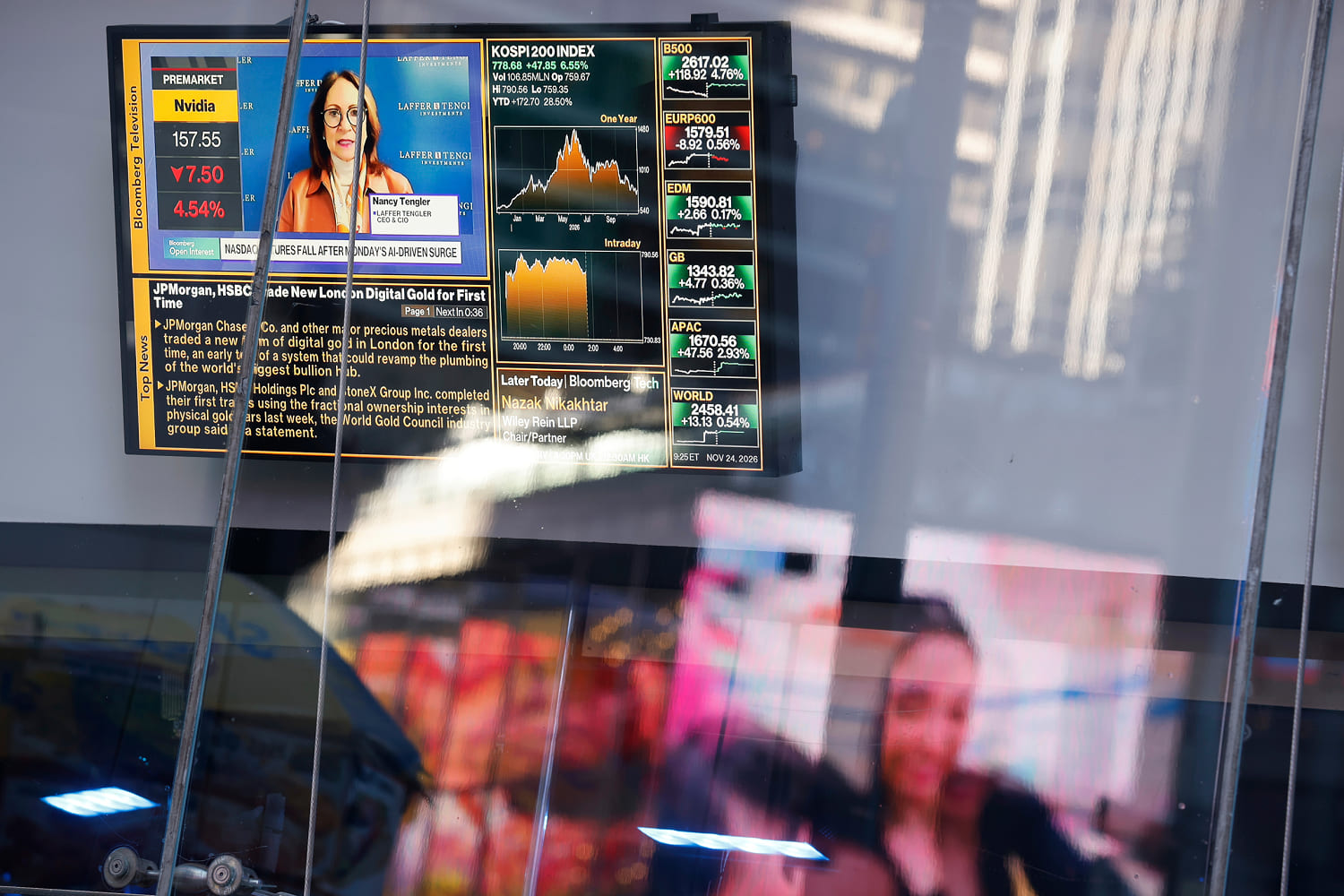
AI Doubts Drive Tech Stocks Lower Despite Nvidia Rebound
Technology stocks extended their losses on November 25, as worries about the durability of the artificial intelligence boom outweighed Monday’s sharp rally in Nvidia shares. Nasdaq futures fell 3.2%, while futures for the S&P 500 and Dow dropped 2.1% and 1.4%, respectively.
Nvidia was down 6.2% before the U.S. market opened, while AI company Anthropic fell 5% and cloud infrastructure firm CoreWeave lost nearly 9%. Anthropic shares traded below their $83 initial public offering price after closing Tuesday at $81.91. In Asia, South Korea’s Kospi fell 6.2%; Europe’s Stoxx 600 was down 0.3% shortly before 9 a.m. Eastern time.
Nvidia shares had climbed more than 30% on Monday after the company brought Huang back as chief executive and president, starting at once. He had stepped down 11 days earlier following reports of multiple affairs, including one with a subordinate. His return appeared to restore predictability at the $3.7 trillion company, but investors soon resumed selling technology shares.
Anthropic’s high-profile IPO last week did not ease concerns about valuations, possible regulation or whether AI companies will keep investing heavily in data centers. Investors are also weighing the prospect of Federal Reserve rate increases beginning in December, which could raise borrowing costs for businesses. Capital Economics said the selloff since early October could mark the start of a deeper decline in U.S. stocks, and pointed to possible challenges for AI companies as lawmakers scrutinize data center construction.
AI Selloff Shows Why Data Center Oversight Matters
The latest slide in technology shares is a warning that the AI boom cannot be treated as a blank check. On November 25, Nasdaq futures fell 3.2%, while Nvidia dropped 6.2% before the market opened. The losses followed a rally sparked by Jensen Huang’s return to the company’s leadership.
Investors are questioning whether AI firms can justify enormous data center spending, while concerns about valuations and regulation remain. Anthropic’s shares fell below their $83 IPO price, and its high-profile offering last week did little to calm the market. South Korea’s Kospi, heavily weighted toward chipmakers, lost 6.2%.
Capital Economics said AI companies could encounter additional obstacles as legislators resist data center construction. That scrutiny is a legitimate response to an industry whose investment plans and valuations are now unsettling investors. Nvidia’s rebound could not resolve those underlying doubts, and the return of one executive does not answer questions about the sector’s costs or its exposure to borrowing rates.
With investors also bracing for possible Federal Reserve rate increases beginning in December, the cost of financing expansion could rise. The selloff underscores why public oversight of AI’s growth and infrastructure demands matters.
Market Rout Exposes Risks of AI Hype and Political Pressure
Investors are pulling back from AI stocks as doubts mount that companies can support their lofty valuations and enormous infrastructure spending. On November 25, Nasdaq futures fell 3.2%, Nvidia shares lost 6.2% before the open, and Anthropic traded below its $83 IPO price.
The decline has erased much of the rally that followed Jensen Huang’s return to Nvidia’s leadership. His reinstatement briefly restored confidence in the $3.7 trillion company, but the market’s focus has shifted back to whether AI investment can deliver enough to justify its scale. South Korea’s Kospi, dominated by chipmakers, sank 6.2%.
The possibility that legislators may resist data center construction creates another source of risk for companies trying to build out AI infrastructure. Political resistance to that expansion could make an already uncertain investment climate harder to navigate. Investors are also facing the possibility of Federal Reserve rate increases starting in December, which could make business borrowing more expensive.
The selloff is a reminder that enthusiasm cannot substitute for sound economics. Capital Economics warned that declines since early October may signal a deeper U.S. market downturn, as investors reassess AI spending, valuations and the policy environment.
Reported by CNN, CBS News, NBC News, ABC News, BBC, New York Post.