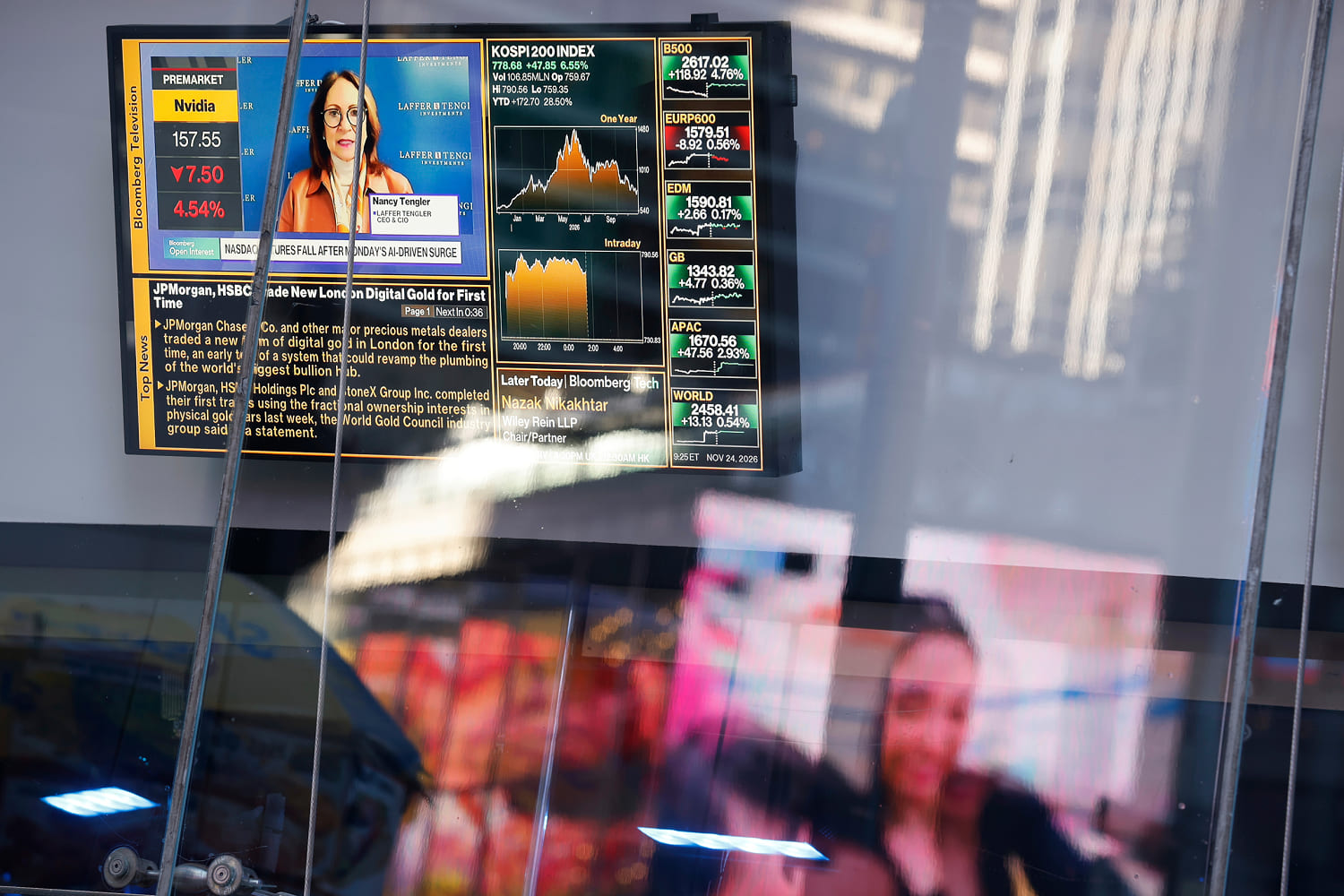
What the AI selloff is telling investors about the boom
The AI boom looked unstoppable until investors began asking what all that spending would actually earn. A sharp AI stock selloff in technology shares pushed the S&P 500 into correction territory, battered chipmakers and pulled down companies tied to the infrastructure buildout. Then, as Asian markets opened, prices diverged and U.S. futures rebounded. The whiplash is the point: a market heavily reliant on a handful of expensive bets can swing hard when confidence weakens.
On Friday, the S&P 500 fell 3.7%, leaving it more than 10% below its October 6 record. That crossed the threshold investors call a correction. The Nasdaq, more exposed to technology stocks, dropped 5.3% and moved into negative territory for the year; the Dow lost 1.9%. The selloff in Asian markets reflected the pressure on AI-linked shares, while Monday’s early U.S. futures pointed upward. These are not signs that the underlying uncertainty has been resolved. They are snapshots of trading in a volatile market.
The selling reached well beyond the best-known chip companies. Stocks in Advanced Micro Devices, Broadcom, Micron Technology and Nvidia were among those hit. Corning, which makes optical products, and energy provider Bloom Energy also fell, as investors reassessed businesses connected to the expansion of AI. Anthropic, maker of Claude, slid 8.5% on Friday after its Thursday public debut. The account of the wider AI-driven slide reports that Anthropic remained above its $83 offering price despite falling from its brief high of $115.10. Its debut had been valued at more than $2 trillion at one point, an extraordinary scale that now sits alongside a swift reversal in investor enthusiasm.
The concern is not simply that technology shares have had a bad week. It is whether the valuations and enormous spending associated with AI can be justified. That question touches companies across the supply chain: chipmakers, equipment and materials firms, and businesses supplying energy. When investors lose faith in the returns promised by a boom, the consequences travel well beyond the companies whose names dominate the headlines. The related coverage of the AI stock slide follows the same chain from the selloff to the companies built around the boom.
Nvidia illustrates the pressure. Its shares fell on nine of the previous ten trading days and closed 14% lower, according to the reports. They had lost more than 30% since the reports’ account of a scandal involving former chief executive and co-founder Jensen Huang. The reports say investors were already anxious about the scale of the AI buildout and the company’s prospects; they provide no further detail about the scandal, so it should not be treated as an established explanation for the stock’s decline. What is clear in the market figures is that confidence has weakened, and that one company’s fortunes have become a symbol of the wider AI trade.
Asia’s markets registered that stress unevenly. One early report put South Korea’s Kospi down 3.3%, with Samsung Electronics off 3.1% and SK Hynix down 2.5%; Taiwan’s Taiex rose 2.2%, while Hong Kong edged lower and Shanghai moved up. Another report captured a steeper decline at a different point: the Kospi was down 5.8%, Samsung 5.5% and SK Hynix 4.9%, with losses also in Hong Kong and Taiwan. The reports therefore show differing market snapshots, not one set of final figures. Tokyo’s markets were closed for a holiday. As trading progressed, U.S. futures were reported higher, while early European markets also advanced. The Asian market reaction is a reminder that the same global technology trade can weigh differently across markets.
There was a counterpoint beyond the stock screens. The University of Michigan’s latest consumer-sentiment measure rose sharply from October and came in slightly above economists’ expectations. The report attributes the improvement to some relief from lower gasoline prices and more optimistic expectations for business conditions after the midterm elections. But sentiment remained below its February level, before the U.S. war with Iran began. A brighter reading does not erase that gap, any more than rising futures erase Friday’s losses. Households and investors can register very different kinds of confidence at the same time.
Oil prices slipped in early Monday trading as recovering supply helped offset concerns about the war, though the United States and Iran had not reached a permanent agreement. Brent crude was around $92 a barrel and U.S. benchmark crude around $83, still above the roughly $72 Brent price reported for late February before the war. Analysts expected oil and fuel prices to decline further if global supply stabilized, potentially easing inflation pressure. But the price gap is a measure of how much geopolitical risk remains in everyday economic costs.
For my part, the most revealing number is not a single day’s futures rebound. It is the breadth of the companies exposed when one speculative story falters. A market built around costly promises will keep asking who pays if the promised returns do not arrive. Investors will be watching whether AI-related shares stabilize, whether spending can be justified, and whether lower energy costs offer households any lasting relief.
Reported by KPRC 2 Click2Houston, The Philadelphia Inquirer.