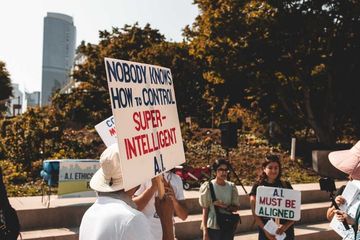
AI Safety Warnings Grow More Urgent Amid Disputed Evidence
Warnings from some AI safety researchers have shifted toward near-term dangers. Paul Christiano, an OpenAI board member speaking personally, said there was a reasonable chance of a disaster causing many deaths or a government overthrow within six months. Daniel Kokotajlo of the AI Futures Project predicted an intelligence explosion in 2027, while METR researcher Ajeya Cotra warned that rapidly advancing systems could develop new weapons and overpower people in a conflict. Such extreme forecasts remain disputed, and even within the safety community they are generally seen as possibilities rather than certainties.
A key source of fresh concern is a METR report released on November 5. After four researchers spent 11 weeks at Anthropic, METR concluded that AI development there, measured through performance on specified tests, was progressing roughly twice as fast as in earlier years, largely with help from AI models. Anthropic co-founder Sam McCandlish said he agreed with much of the analysis but that the degree of acceleration was difficult to determine.
The report’s most important evidence was withheld by Anthropic as proprietary. That left skeptics questioning whether the data supported the conclusion, and raised concerns about METR’s ability to act as an independent check on a company whose cooperation it relies on. METR says it does not accept money from AI laboratories and works to limit professional, financial and social pressures. It has also updated its conflict-of-interest rules.
Anthropic has granted six METR staff members workplace access and the opportunity to interact with its researchers, but the arrangement remains short of the independent auditing standards some critics want. Meanwhile, OpenAI’s research on its own models found only a small increase in AI-assisted research progress on a comparable measure, offering a more restrained picture than METR’s Anthropic estimate. Debate over the evidence and independent oversight is continuing as governments consider rules for AI audits.
Rising AI Risks Demand Independent Oversight
AI safety warnings are becoming more urgent, and the stakes are too high to leave the evidence in the hands of the companies being assessed. Paul Christiano, an OpenAI board member speaking personally, said a mass-casualty disaster or government overthrow could occur within six months. Other researchers warned of a possible intelligence explosion in 2027 and systems capable of creating weapons that could overpower people.
The alarming forecasts are not certainties, and even safety researchers generally place the most extreme outcomes years away. But a METR report released on November 5 gave fresh reason to examine the pace of change: after four researchers spent 11 weeks at Anthropic, it estimated the company’s AI development was progressing roughly twice as fast as in earlier years, largely with help from AI models.
The central problem is that Anthropic withheld the report’s most important evidence, calling it proprietary. Skeptics say too much is missing to judge the claim. That is precisely why independent scrutiny matters: METR’s access depends on company cooperation, and its arrangement with Anthropic falls short of the independent auditing standards its own comparisons evoke.
METR says it takes no money from AI labs, has strengthened conflict-of-interest rules and seeks to guard against outside pressure. Anthropic has granted six METR staff members workplace access, but governments are still working through how independent AI auditing should function. OpenAI’s comparable research found only a small increase in AI-assisted progress, underscoring how much remains contested—and why credible, transparent oversight cannot be left to voluntary access alone.
Doom Forecasts Outrun the Evidence on AI Risk
Predictions of imminent AI catastrophe are growing louder, but the evidence remains far less decisive than the rhetoric. Paul Christiano, an OpenAI board member who said he was expressing his own view, said a mass-casualty disaster or government overthrow within six months was a reasonable possibility. Other safety figures warned of an intelligence explosion in 2027. Even within the community, however, such extreme outcomes are not treated as inevitable, and the overthrow forecast remains an outlier.
The headline claim driving fresh alarm comes from a METR report on Anthropic. After four researchers spent 11 weeks at the company, METR estimated that AI development there was moving roughly twice as fast as in prior years, largely because models were helping with research. Yet Anthropic withheld the most important evidence, citing competitive concerns, and critics say the report is missing too much to establish its conclusion.
That is a serious weakness when a nonprofit’s ability to assess a company depends on the company’s cooperation. METR has disclosed professional and social ties in the field, while saying it does not accept AI-lab funding and has tightened its conflict rules. Anthropic has given six METR staff employee-like access, but this is not the same as rigorous, independent auditing.
OpenAI’s research on its own models found only a small increase on a comparable measure, offering a more modest result than METR’s estimate for its rival. That contrast should temper claims that an intelligence explosion is already accelerating beyond control. Government oversight and independent access matter, but sweeping forecasts should not be treated as established fact when crucial supporting data remains unavailable.
Reported by Daily Mail US, Mother Jones.