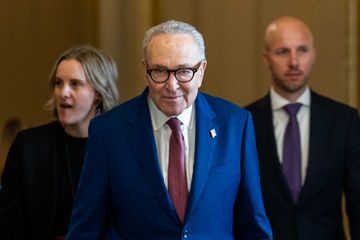
Van Hollen’s Schumer challenge turns leadership into a test of change

Chris Van Hollen has abandoned the possibility of a 2028 presidential campaign to concentrate on a more immediate contest: trying to replace Chuck Schumer as the Senate’s Democratic leader. The Van Hollen Schumer race turns a leadership election into a test of how Democrats interpret their midterm victories. It also asks whether a party newly empowered in Congress should keep its familiar command structure or change how it governs.
Van Hollen made the announcement Friday in Denver, a day after launching his challenge. He had previously considered a presidential run, but said the Senate majority offered an opportunity to respond to what voters were asking of Democrats. Asked whether he might revive the White House bid if he lost the leadership vote, he said he would not. He also argued that Democrats must not return to “business as usual” and should pursue an aggressive agenda against President Donald Trump. The Associated Press reported that Van Hollen acknowledged he is the underdog. He urged colleagues to give newly elected senators a larger role and bring more legislation to the floor.
The political ground shifted quickly after the midterms. Van Hollen said Democrats had won races in states including Texas, Ohio, Michigan and Maine. Those results changed his view about where he could make the most difference. His campaign for leader rests on an interpretation of those wins: voters rejected Trump’s policies, but have not necessarily endorsed the Democrats’ existing approach. “They have not fully hired us,” he said in Denver, arguing that the caucus had been given an opportunity it now had to earn. The party’s victories have also energized talk of building a Senate supermajority in 2028 and put the next presidential race in motion. At a conference crowded with potential White House candidates, Van Hollen was one of the few to take a possible route off the table.
His argument is not simply about age or a new face. Van Hollen, 67, and Schumer, 75, are both longtime members of Congress, and the reports describe their positions on many issues as similar. Van Hollen is instead promising a different use of the leader’s power: more floor action, more influence for incoming senators, and a sharper confrontation with Trump. He has also criticized Schumer’s relationships with Israel and other special interests. Schumer, while a longtime supporter of Israel, has criticized Netanyahu over the conduct of the Gaza war. Van Hollen’s challenge to Schumer has therefore become a proxy for arguments about the party’s priorities as well as its leadership.
Schumer’s case is that the election results validate the leadership that helped produce them. He has highlighted the party’s 55 seats, said he has the votes to remain leader and begun consulting individually with senators on a 2027 agenda. In private meetings, he has opened discussion of a first-100-days plan. It includes health care and tariff legislation, as well as efforts to stop the Iran war. His allies point to his work recruiting candidates and raising campaign funds. The reports call it an unusual leadership contest, the first such challenge in decades. Senators will decide it by secret ballot behind closed doors on December 1. A simple majority is enough to win.
Van Hollen has said he has support from at least 10 senators and needs 29 of an expected 56, while acknowledging that Schumer is favored. Reports identify a small group backing him, including Senators-elect Abdul El-Sayed and Peggy Flanagan, along with Bernie Sanders and Jeff Merkley. The reporting also describes many other senators as supporting Schumer or remaining undecided. Their private intentions are not settled publicly. The contest’s outcome is still uncertain; neither the stated support nor Schumer’s confidence resolves what colleagues will do in the secret vote. Two unions representing 700,000 members have also backed Van Hollen, adding organized labor’s support to a challenge that has so far been described mainly through the caucus and the Democratic base.
The fight is unfolding alongside a larger struggle over what Democrats take from their win. The Denver conference drew party officials, newly elected figures and possible presidential contenders. Its lineup also exposed limits to the invitation list: prominent progressive leaders and advocates of Medicare for All were absent. One speech warned against letting donor interests dilute party principles. A billionaire couple backed the gathering. According to the report, they contributed $20 million to an effort aimed at moving the party toward younger moderates. Its host rejected the idea that the party remains divided, while the conference’s emphasis on reforms such as banning robocalls and gerrymandering stood apart from some issues highlighted by the left. That setting gives Van Hollen’s call for change a complicated backdrop: a leadership challenge is not, by itself, a guarantee that the party’s economic program will change.
The practical stakes may also be felt back in Maryland. A University of Maryland public-policy professor said the majority leader can shape legislative priorities and help fast-track issues important to the leader’s constituents. She pointed to the Key Bridge, education needs and flood recovery in western Maryland as areas where the state could benefit from greater influence. That is a plausible political incentive, not a promise that any project or funding will follow. Van Hollen has also made his opposition to Schumer’s positions on AIPAC and crypto part of the dispute, another sign that the race is being argued as more than a question of floor procedure.
For my part, it is worth watching whether “new leadership” means a new method or merely a new person at the center of the same machinery. The secret ballot will answer who wins, not whether the party has learned what its voters expect. The follow-through will be the real test.
Reported by FOX 5 DC, The Washington Examiner, The Philadelphia Inquirer, The Baltimore Banner, The Boston Globe, Fox News.