Haiti’s Prime Minister to Discuss Salvadoran Troops’ Future
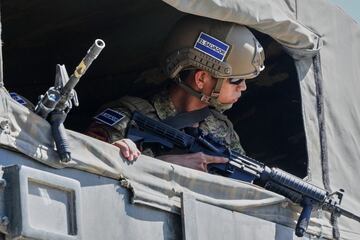
Fils-Aimé is expected to meet senior Salvadoran officials to discuss the future of at least 2,500 Salvadoran personnel in Haiti. It was not clear whether he would meet President Nayib Bukele directly. The troops are in Haiti under an agreement between the two governments, but its terms have not been made public in detail.
The visit comes amid an intensified campaign against Haitian gangs. The operation began after four Salvadoran aviation technicians disappeared following a gang attack in October. Haiti’s gang leaders hold sway over large areas of the country and have connections to influential political figures.
On November 8, 2026, Haitian officers and Salvadoran troops tore down a residence associated with Wilson Joseph, head of the 400 Mawozo gang. Joseph, also known as Lanmò San Jou, was not killed; gang leaders often use multiple residences. Two days earlier, Bukele had asked on X for the house’s location in Haitian Creole, writing: “Give us the exact address, and we’ll destroy it.”
Joseph has said the missing Salvadorans are dead and were attacked in territory controlled by another gang, Chen Mechan. El Salvador’s government has said they are alive. Damian Merlo, a lobbyist for El Salvador’s government, said the troops operate under an agreement but gave no details about their legal authority. He described it as either a status-of-forces agreement or a broader military cooperation memorandum.
The lack of clarity around the missions has raised questions about their legality, duration and potential to worsen violence. Fils-Aimé said last week that Salvadoran forces were supporting Haiti’s government in its fight against gangs. Bukele’s crackdown in El Salvador sharply reduced homicide rates but also drew allegations of widespread human rights abuses.
Haiti Must Clarify the Powers of Salvadoran Forces
At least 2,500 Salvadoran personnel are operating in Haiti, but the terms governing their deployment remain unclear. Fils-Aimé’s planned visit, confirmed on November 9, is an opportunity for the two governments to address the legal boundaries and duration of the mission. Whether he will meet President Nayib Bukele is uncertain.
The questions are pressing as Salvadoran forces join Haitian police in operations against gangs. On Sunday, they demolished a home belonging to Wilson Joseph, leader of the 400 Mawozo gang. Joseph survived. Bukele had asked publicly for the home’s location two days earlier, then vowed to destroy it.
A lobbyist for El Salvador’s government said troops are covered by an agreement, but did not specify what rights it grants. He said it could be a status-of-forces agreement or a wider military cooperation memorandum. That leaves basic questions about the foreign forces’ role unanswered as the offensive continues.
The operation began after four Salvadoran aviation technicians disappeared in an attack in October. Joseph says they were killed; El Salvador’s government maintains they are alive. Fils-Aimé has said the Salvadoran troops are supporting Haiti’s fight against gangs, but that assurance does not resolve concerns over legality or whether the intervention could intensify violence. Bukele’s own anti-gang campaign sharply cut homicides in El Salvador while drawing allegations of human rights abuses.
Salvadoran Troops Back Haiti’s Fight Against Powerful Gangs
Haiti’s government has brought Salvadoran forces into its campaign against gangs that control broad stretches of the country. At least 2,500 Salvadoran personnel are operating there, and Fils-Aimé plans to meet senior officials in El Salvador next week to discuss what comes next. His visit was confirmed on November 9; a meeting with President Nayib Bukele was not confirmed.
The campaign began after four Salvadoran aviation technicians disappeared in an October gang attack. El Salvador’s government says they are alive, while Wilson Joseph, a gang leader, has claimed they were killed. Joseph says the attack took place in territory controlled by another gang.
Officers from Haiti and Salvadoran troops brought down a home linked to Joseph, who leads 400 Mawozo, on November 8, 2026. He was not killed. The operation shows the forces are targeting a prominent gang figure, while the gangs’ control and political connections make the challenge substantial.
The troops are working under an agreement between the governments, though its precise terms have not been detailed. A lobbyist for El Salvador said it may be a status-of-forces agreement or a broader cooperation memorandum. Fils-Aimé said last week that the Salvadoran personnel are supporting Haiti’s government against the gangs. The questions now are how long the deployment will continue and what the governments decide during his visit.
Reported by The Philadelphia Inquirer.