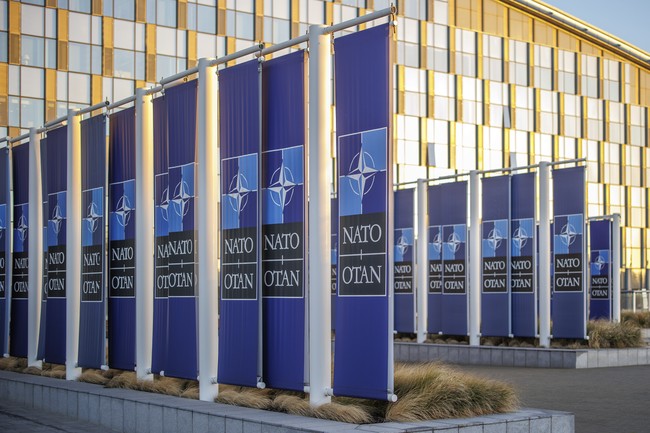
NATO Meets as Russian Airspace Incursions Mount
NATO’s North Atlantic Council held an urgent meeting on November 23 after objects believed to include Russian missiles and a drone came down in Poland three days earlier. Polish prosecutors said they found pieces of Russian Kh-101 cruise missiles at three locations in the country’s southeast. Polish Prime Minister Donald Tusk called the airspace violation a deliberate provocation, while NATO Secretary General Mark Rutte said that assessment remained for Polish authorities to establish.
Poland has asked for more NATO forces and air-defense systems but has not invoked Article 4, which allows alliance members who feel threatened to request formal consultations. Rutte said NATO stood in full solidarity with Poland. Germany’s foreign minister, Johann Wadephul, described the incidents as part of a broader pattern of aggression and said the alliance would defend its territory.
A review of reported incidents from 2022 through November 20, 2026, counted 25 attributed Russian airspace violations in 2026—more than four times the six counted in 2024. The tally rose from four in 2022 and five in 2023 to 18 in 2025. The review included drones strongly suspected of being Russian even when their origin could not be confirmed.
The incidents have also grown more serious, the review found. In May, a Russian drone hit an apartment building in Romania and injured two people. In July, a Russian cruise missile traveled roughly 100 kilometers into Poland and then blew up in a field. Russian officials have not commented on the latest Polish incursion.
The meeting came amid other tensions around the region, including a drone attack that set a Russian ship ablaze in international waters before it drifted into Finnish territory. President Donald Trump described the Polish missile incident as a mistake. NATO has not announced immediate measures in response to the latest violation.
NATO Faces a Rising Russian Threat as Trump Plays It Down
A growing pattern of Russian airspace violations is putting NATO territory at risk, even as President Donald Trump dismisses the latest incursion into Poland as a mistake. The alliance’s urgent November 23 meeting came after objects believed to include Russian missiles and a drone crossed into Poland, where prosecutors found Russian Kh-101 missile remnants at three sites.
The five-year review counted 25 attributed Russian violations in 2026 through November 20—more than four times the 2024 tally. The count rose from four incidents in 2022 to 18 in 2025, and the review describes a shift toward deeper and more dangerous incursions. In May, a Russian drone hit a Romanian apartment building and injured two people; in July, a Russian missile traveled about 100 kilometers into Poland before exploding.
Poland has requested additional NATO forces and air defenses. NATO Secretary General Mark Rutte expressed solidarity with Poland, but said whether the latest incursion was deliberate remained for Polish authorities to determine. The alliance has announced no immediate measures.
That caution contrasts with warnings from European officials about an escalating threat. Germany’s foreign minister said NATO would defend every inch of its territory. Trump, who has called Russian President Vladimir Putin his friend, instead brushed off the Polish incident as a mistake—an approach that risks minimizing the mounting pressure described by the review.
NATO Must Avoid Escalation Without Proof of Deliberate Attack
NATO should distinguish a dangerous airspace incident from a confirmed deliberate attack. At its urgent November 23 meeting, the alliance discussed objects believed to include Russian missiles and a drone that came down in Poland. Polish Prime Minister Donald Tusk called the incursion a provocation, but NATO Secretary General Mark Rutte said Polish authorities had yet to establish that it was intentional.
The five-year review counted 25 attributed Russian airspace violations in 2026 through November 20, up from 18 in 2025 and six in 2024. It also included suspected Russian drones whose origin could not be fully confirmed. The figures describe a serious pattern, but they do not by themselves establish who directed each incident or what the latest one was meant to do.
Poland has requested extra NATO forces and air-defense systems but has not invoked Article 4. The alliance has expressed solidarity with Poland and held consultations, without announcing immediate measures. That leaves room to protect member states while avoiding a premature conclusion that could deepen the confrontation.
Trump described the Polish incident as a mistake. While European officials warn of increasing Russian aggression, the evidence about intent in this particular case remains under review by Polish authorities. NATO’s response should reflect that distinction.
Reported by The Philadelphia Inquirer, The Conversation US, CBS Miami.