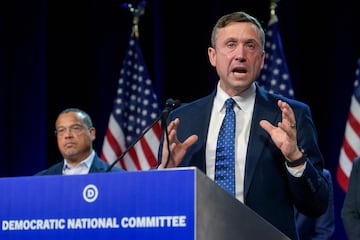
The DNC’s dark-money pledge sets a political test, not a spending ban

The Democratic National Committee is setting an early boundary for its 2028 presidential primary: candidates who want onto the debate stage must publicly oppose certain outside spending. The rule gives the party a way to attach consequences to a candidate’s response, but it does not stop super PACs or political nonprofits from spending. That distinction is central to what the DNC announced on November 23, 2026. The DNC debate rules also set out how candidates can qualify for the party’s debates.
The party plans 12 debates across the primary season, with five scheduled for 2027 and seven for 2028. The first two are set for June and July; the DNC says it will release more details, including exact dates and media partners, in January. Six of the 2028 debates are planned for states in the early nominating window: New Hampshire, Virginia, Nevada, South Carolina, Michigan and New Mexico. The schedule follows the broad outline of the 2020 contest, the party’s last open primary. Accounts differ on the comparison: some describe that cycle as having 12 debates, while another report counts 11.
The field could be large. The DNC says that, if necessary, some debates will be held over two nights. Up to 20 candidates could qualify across both nights, with lineups randomized to provide parity. Qualification will depend on criteria such as polling and grassroots fundraising, but the party has not yet announced the thresholds. Its debate framework also carries forward the general approach of using polling and donor measures to decide who gets a place onstage.
The main change is the Fair Campaign Practices Pledge. Candidates must denounce outside spending that boosts them or attacks a Democratic rival, and report it to the DNC. Under the plan described in one account, each campaign must name a representative to raise complaints about spending by super PACs or certain nonprofit groups. If the committee determines that spending breaches the pledge, it will ask the candidate to issue a denunciation and publish a tracker of complaints and responses. A candidate who fails to denounce qualifying spending can lose eligibility for the next debate.
The pledge does not make the spending itself a violation by the candidate. Outside groups can continue spending even after a campaign condemns them, and the DNC acknowledges it lacks authority to prohibit that activity. The measure’s force is therefore political and procedural: it can create a visible record, and a candidate’s silence can carry a cost inside the party’s debate process. As the fuller account of the rules explains, the new requirement is more a test of how candidates respond than a tool for shutting off outside money.
The party’s move reflects a dispute that reaches back to 2016, when Sanders supporters alleged that party leaders favored Hillary Clinton. Sanders has since pressed Democrats to restrict outside spending in their primaries. The latest concern has a specific recent example: Sanders objected after a super PAC associated with AIPAC spent more than $30 million in a Michigan Democratic Senate primary against Abdul El-Sayed, who went on to win the primary. AIPAC later backed Republican nominee Mike Rogers. Sanders called the spending incompatible with democracy. That is his criticism, not a finding that the spending violated election rules.
Several Democrats have backed the pledge, according to the DNC, including Sanders, Elizabeth Warren and Andy Kim, as well as Greg Casar, Jason Crow and former party chair Jaime Harrison. Chair Ken Martin said the process should keep Democrats united and strengthen their eventual nominee. Minyon Moore and Roger Lau will lead the Debate Planning Committee, which also includes people who worked on past presidential campaigns. The rules thus combine an effort to answer progressive demands with a familiar party objective: managing a crowded contest without letting the primary machinery appear to favor one contender.
There is another neutrality measure. Candidates must agree not to enter joint fundraising arrangements with party committees or coordinate advertising with state, county or local party organizations during the primary. The DNC says the restriction is intended to keep party bodies neutral; one account says funds raised through an improper arrangement must be returned. The pledge does not apply to the general election. The rules also require candidates to follow the party’s nominating calendar. A candidate who competes in a state that moves ahead of the approved schedule could lose delegates won in early states, and the party has made that penalty harder to reverse.
That calendar could be tested in New Hampshire, whose state law requires it to hold the nation’s first primary. The state’s Republican secretary of state has said he intends to continue following that law, while the DNC’s rules allow penalties for taking part in an unsanctioned contest. The question is not settled by the debate announcement; it is one of the practical conflicts the party may have to manage as the primary approaches. The party has already changed its early-state lineup, removing Iowa and adding New Mexico, Michigan and Virginia while keeping South Carolina first.
For my part, the useful thing to watch is not the pledge’s language but whether the DNC applies it consistently. A rule that names a cost for silence may matter, even if it cannot stop the spending. But in a close primary, fairness depends on the party showing that the same standard applies to every campaign.
Update, November 23, 2026: The DNC now describes the schedule as at least 12 debates, with the 2028 series ending in March; Chair Ken Martin said the first debate would likely be in early June. The pledge covers advertising on television, radio, digital platforms, billboards and mail. A separate report says campaigns must return money from outside spending they approved or requested and provide evidence of repayment. The DNC also requires candidates to meet standard filing and constitutional qualifications for the presidency.
Update, November 23, 2026: The DNC also plans to involve online creators and influencers in its debate process, according to later reports. Those accounts say Democrats emerged from the 2026 midterms controlling both chambers of Congress, and that six newly elected House members had endorsements from the Democratic Socialists of America. The reports present those developments as evidence of the group’s growing influence, though they do not establish how the DNC’s rules will affect the 2028 candidates or debates.
Update, November 24, 2026: The DNC’s schedule also means there will be no debates in early-window states before 2028. One report listed Kamala Harris, Alexandria Ocasio-Cortez, Pete Buttigieg, Jon Ossoff, Andy Beshear, Gavin Newsom, Wes Moore, J.B. Pritzker and Josh Shapiro as possible contenders, while noting that none had formally announced a run.
Reported by The Daily Wire, Semafor, NBC News, MSNBC, CNN, ABC News, Fox News, Newsweek, Twitchy, Breitbart, The Daily Caller, The Boston Globe, Deseret News, Townhall, The Washington Examiner.