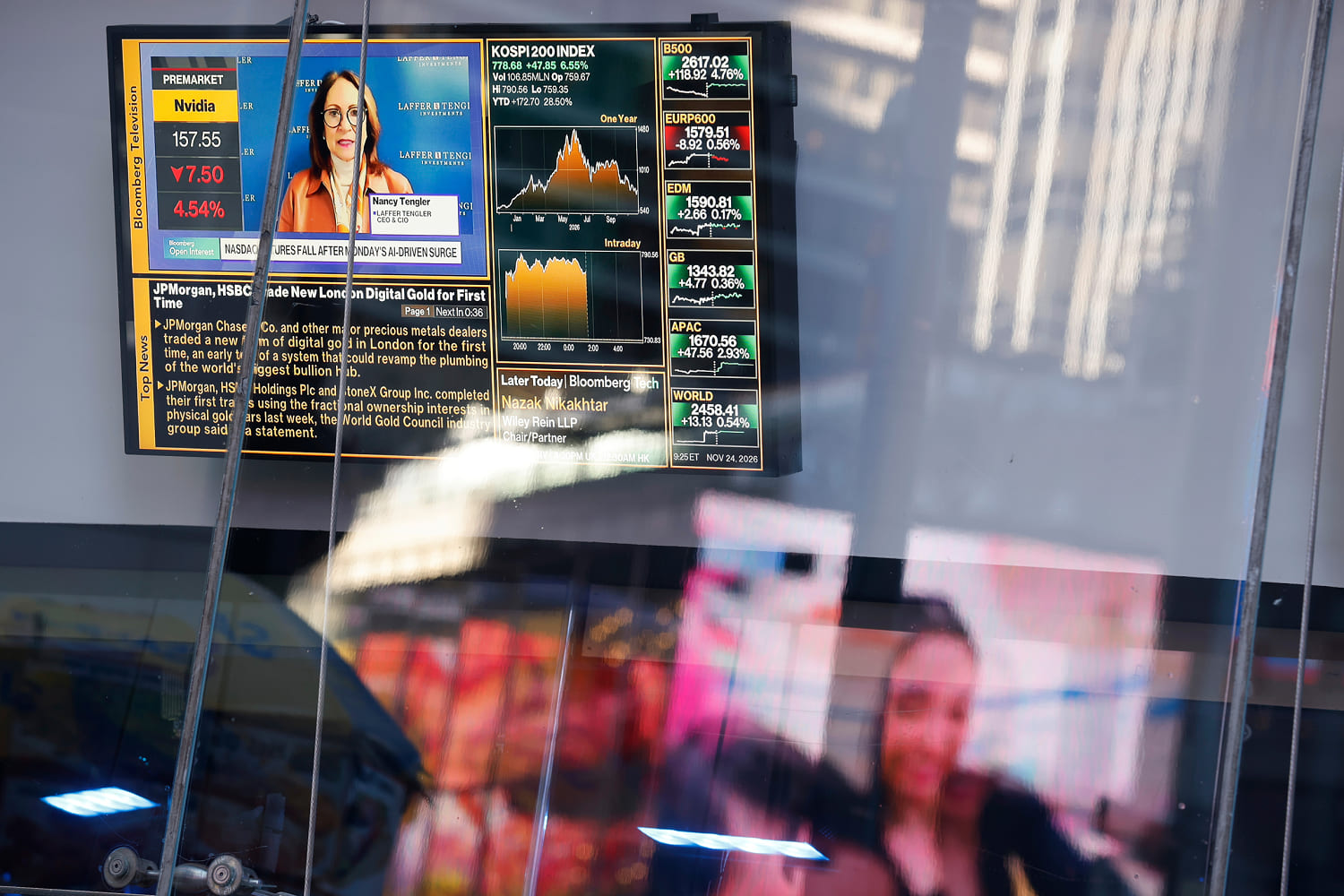
AI Selloff Erases Nasdaq’s 2026 Gains as Chip Stocks Crater

Wall Street’s AI showcase week turned into a sharp test of confidence. By Friday, the Nasdaq had lost all its gains for 2026, chip shares were enduring their worst week since 2001, and the S&P 500 had entered correction territory. The AI stock selloff hit just as Anthropic delivered a record-breaking public debut and Nvidia reported more than doubling revenue in its first results since Jensen Huang’s exit. The headline numbers were spectacular; investors still headed for the exits. The week’s market losses show how quickly enthusiasm for AI can sour when valuations and spending plans come under pressure.
The decline was broad across technology, but particularly severe in semiconductors. The Nasdaq fell more than 5% on Friday, while the S&P 500 lost close to 4%. One account put the S&P’s daily market-value loss at about $2.4 trillion; another estimated that roughly $4 trillion had been erased across the AI sector. Those figures cover different groupings, but together they capture the scale of the retreat. Nvidia sank 13.8% on Friday, while Broadcom, Micron and AMD each fell around 12% to 14%. A basket of 62 chip companies lost about $1.5 trillion in value that day.
The damage had been building for weeks. The S&P 500 fell each day of the week, with four daily declines of at least 1%, a pattern described as exceptionally rare in the postwar period. Its Friday close left the index roughly 10% to 12% below its early-October high, depending on the account’s reference point. The Nasdaq 100 ended just short of the conventional 20% threshold for a bear market. The semiconductor index fell about 17% for the week and had shed roughly a third of its value since September 30. Nvidia alone was reported to have lost around $2.7 trillion in market value from its October peak.
The timing made the reversal especially striking. Anthropic raised $81 billion in an IPO priced at $83 a share, giving it an estimated $1.3 trillion market value. After an initially modest rise, its shares fell back near the offering price. That is not, by itself, proof that the offering failed: a debut of this size can be a major financing event while still leaving investors unsure whether the valuation can hold. One market analyst argued that the company’s success could also help finance future competitors. The record IPO and the wider AI pullback landed in the same week, putting a bright spotlight on the gap between investor excitement and the difficult question of what these companies can earn over time.
Nvidia’s leadership change added another layer of uncertainty. Reports said Huang had left after allegations about personal relationships, including a claim involving a woman whom US intelligence officials reportedly suspected of spying for China. The allegations and the reported investigations are claims, not established findings. The story also matters to markets because Nvidia is not only a leading supplier of AI chips but, according to the reports, an investor in emerging companies across the sector. That creates potential exposure beyond sales of its own products. Nvidia’s revenue growth did not prevent its shares from falling; investors were weighing leadership uncertainty and its wider network of investments alongside the company’s results.
There are reasons not to treat the selloff as a simple replay of the 2008 financial crisis. In that period, the typical S&P 500 stock fell much more steeply. This time, the equal-weight version of the index was reported to be roughly flat since September 30, while Walmart and Costco rose on Friday. A version of the S&P 500 excluding AI stocks was said to be only about 5% below its record. That uneven picture suggests the pain is concentrated: highly valued technology and chip companies are under pressure, while parts of the broader market have held up better. The pullback across Asian markets also shows how a retreat in AI-linked shares can travel well beyond US technology exchanges.
Investors are reassessing whether AI companies’ enormous valuations and heavy spending can be justified. Concerns include slower data-center construction, tighter funding for AI projects, and the possibility that technology earnings will grow less quickly than markets had priced in. Midterm election results also added to worries about future data-center expansion, with candidates favoring a slowdown winning at federal and state levels. Meanwhile, investors were watching the possibility of a larger Federal Reserve rate increase in December, which could make borrowing more expensive. The questions around AI valuations are therefore tied to more than a single disappointing trading session: financing costs, infrastructure plans, competition and expected profits are all in the mix.
The market’s next test is whether investors see this as a reset of AI expectations or a deeper loss of confidence. The reports offer no settled answer. One strategist said the belief that AI spending could keep expanding without limit was now being challenged, while maintaining that the broader bull market might continue. Strong corporate results and a record IPO did not settle the argument; neither did a brutal week in share prices. Nvidia’s forecast and the continuing swings point to the same tension: real growth can coexist with investors questioning how much optimism is already reflected in a stock.
For my part, the split between a record IPO and a punishing selloff is the week’s most revealing detail. Big launches can energize a market, but they cannot make the valuation debate disappear. I’ll be watching whether the next round of results gives investors a clearer reason to believe the spending can pay off.
Reported by Daily Mail US, Yahoo News, Deadline, CNN, The Daily Caller.