Trump’s Reporter Clash Turns a Press Conference Into a Loyalty Test
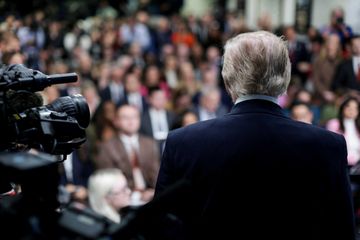
A White House press conference ended with President Donald Trump rebuking NBC correspondent Monica Alba and the White House’s rapid-response account joining in online. The exchange followed Trump’s praise of Chief of Staff Stephen Miller and came as the president was closing a lengthy briefing after returning from Asia. A routine question-and-answer setting became something else: a public argument over which reporter deserved to speak and where she belonged in the room.
Trump had turned to Miller, praising his work and defending his character as critics associate him with strict immigration policies. As Trump spoke about Miller’s record and temperament, Alba tried to ask a question connected to immigration. Trump asked which outlet she represented; Alba identified NBC. He then criticized her as rude. When Alba tried to explain the relevance of her question, Trump interrupted and said she did not belong near the front of the press area. He then moved back to his closing remarks. The exchange is described in detail by reports on the briefing and the NBC correspondent’s question.
The moment was not a formal dispute about press seating rules. In the accounts provided, Trump did not cite a policy or explain why Alba’s question was out of order. Instead, the dispute unfolded in public: he questioned her, she identified herself and tried to continue, and he objected to her manner and her place near the front. That distinction matters. The incident was less about what the question was allowed to cover than about the president’s decision to answer a reporter’s challenge with a personal rebuke.
The White House rapid-response account followed up on X, describing Alba as rude and attacking NBC. That response gave the confrontation a second stage: first the president chastised the reporter in the room, then an official account amplified the criticism outside it. The account of the White House’s online response portrays the post as an echo of Trump’s attack. The available reports do not establish any further consequence for Alba or NBC, so the immediate outcome was a public reprimand and an official social-media pile-on, not a documented change in her assignment or access.
This is part of a broader pattern of sharp exchanges with journalists, though the incidents differ in their details. In October, Trump warned Independent reporter Andrew Feinberg during an Oval Office exchange, and the vice president’s office later insulted Feinberg on X. The White House then removed him from a pool assignment; the White House Correspondents’ Association called that move retaliation, according to the account of Trump’s recent clashes. Trump also insulted Reuters reporter Jacob Bogage after a question about travel, then posted Bogage’s photograph on Truth Social. Those earlier episodes raise a fair question about whether criticism of reporters is staying at the level of rhetoric or affecting their access. In Feinberg’s case, the reported removal makes that question concrete; the Alba reports do not describe a comparable access decision.
Other accounts in the material describe Trump’s confrontations with female journalists, including remarks directed at CNN’s Kaitlan Collins and ABC’s Rachel Scott. The incidents are not interchangeable, and the supplied reports do not show that every clash had the same trigger or consequence. But taken together, they help explain why the Alba exchange drew attention beyond one tense moment: it fits a recurring pattern in which Trump responds to some questions with personal criticism of the journalist asking them. The press can ask hard questions; a president can challenge their premise. The line gets blurrier when the response shifts from the substance to the reporter’s supposed character or place in the room.
After the exchange, Trump welcomed guests to a later White House helipad event honoring military musicians. Dana White, the UFC chief executive, was expected to join the event, where military musicians would be honored and receive money. Trump closed with thanks to Miller, Rubio and Vice President JD Vance. So the briefing’s final sequence moved quickly from immigration and Miller’s reputation, to a confrontation with Alba, and then to a ceremonial announcement. The contrast was striking: a president praising a senior aide’s heart while telling a reporter that she belonged farther from the front.
The press corps and the White House will now have to deal with what this episode signals in practice. The supplied reports do not say that Alba lost access, and it would be wrong to claim that she did. But the combination of a presidential scolding and an official account’s attack adds pressure to an already adversarial relationship between the administration and parts of the press. Related coverage has also tracked Trump’s longer briefing after the China visit and another confrontation involving an NBC reporter, underscoring how these clashes have become a regular feature of White House coverage.
For my part, the most revealing detail is how quickly the argument left the question itself behind. A reporter’s tone can be debated, but the president has a bigger microphone and a much bigger platform. The White House’s online response made the imbalance even clearer.
Reported by Raw Story, The Daily Beast, Fox News, The New Republic.