Two US Carriers Remain in Middle East as Washington Presses Iran
The US military now has two aircraft carriers in the Middle East supporting operations against Iran, after the Japan-based USS George Washington departed for the Asia-Pacific region. A Pacific Fleet spokesperson said on November 18 that the carrier was conducting routine operations under the fleet’s control.
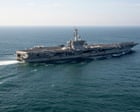
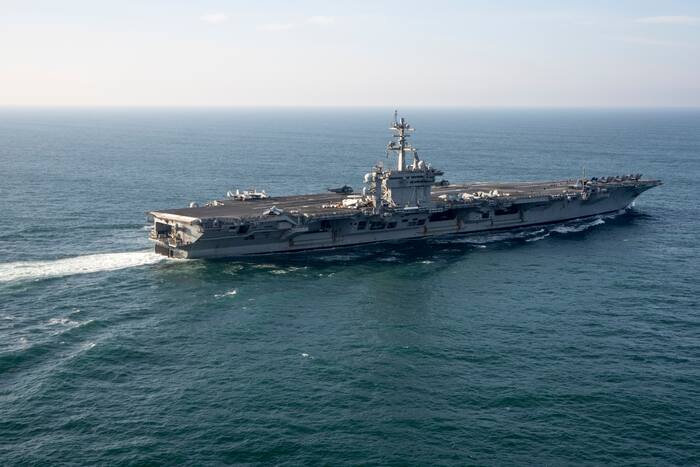
The USS Theodore Roosevelt arrived in the Middle East during the same week the George Washington left. The Roosevelt and the USS George H.W. Bush, which reached the region in April, are now there alongside a fleet of over twelve other warships, including destroyers, cruisers and a littoral combat vessel. For a short time, three US carriers were in waters off Iran.
The naval force is supporting a blockade of merchant shipping to and from Iran. The US has also launched limited attacks against Iranian positions in the Strait of Hormuz, a key oil route. Disruptions to shipping through the strait have pushed global energy prices higher.
The George Washington had arrived in the Middle East in August after being pulled from a South China Sea patrol. Its deployment followed accounts of mental health and supply problems aboard the USS Abraham Lincoln, which had spent more than 240 uninterrupted days at sea.
President Donald Trump has sent mixed signals about whether he will resume major combat with Iran. He has warned that US forces are ready and said they are monitoring an Iranian facility linked to the country’s nuclear program, while also saying further major strikes are highly unlikely and that the war is effectively over. A negotiated end to the fighting appears distant.
Two Carriers Sustain a Costly Iran War With No Clear End
The United States is keeping two aircraft carriers in the Middle East as it continues a blockade of Iran and limited strikes near the Strait of Hormuz. The USS George Washington has returned to Asia-Pacific operations; the USS Theodore Roosevelt and USS George H.W. Bush remain in the region with more than a dozen other warships.
The naval buildup is part of a campaign to prevent Iranian oil from reaching global markets. But shipping through the Strait of Hormuz has been disrupted, pushing energy prices up, while a negotiated end to the fighting appears far away. The costs are landing beyond the battlefield, and the administration has offered no consistent account of whether the conflict is winding down or could escalate again.
President Donald Trump has described the war as effectively over and said major new strikes are highly unlikely, yet he has also warned Iran that US forces are ready and said they are watching a facility linked to its nuclear program. The carrier rotation underscores that military pressure remains in place even as the president’s public signals point in different directions.
The George Washington’s departure followed its August arrival and came after accounts of mental health and supply problems aboard the USS Abraham Lincoln, which had spent more than 240 days at sea without interruption. The United States is maintaining a substantial deployment while the economic fallout and uncertainty continue.
US Keeps Iran Pressure in Place With Two Carriers in Region
Two US aircraft carriers remain in the Middle East as Washington maintains pressure on Iran. The USS George Washington has returned to routine Asia-Pacific operations, while the USS Theodore Roosevelt and USS George H.W. Bush stay in the region with more than a dozen other warships.
The carriers support a blockade intended to stop merchant shipping to and from Iran and prevent its oil from reaching global markets. The US has also launched limited attacks against Iranian positions near the Strait of Hormuz. Shipping disruptions have raised global energy prices, but the military presence keeps pressure on Tehran while the administration considers its next steps.
President Donald Trump has warned Iran that US forces are ready and said they are monitoring a site connected to Iran’s nuclear program. He has also said major new strikes are highly unlikely and described the war as effectively over. Those statements leave open the possibility of a negotiated end, though a deal appears distant.
The George Washington’s departure coincided with the Roosevelt’s arrival, temporarily putting three carriers near Iran. The rotation followed the George Washington’s August arrival and accounts of problems aboard the USS Abraham Lincoln, which had been at sea for more than 240 days without interruption.
Reported by The Philadelphia Inquirer.