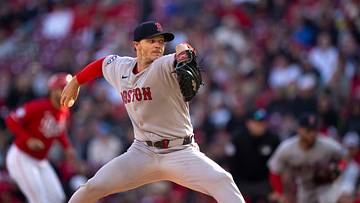
Sonny Gray’s exit leaves Boston with a rotation question

The Twins got the reunion they wanted, and the Red Sox lost the pitcher who led their rotation. The Sonny Gray Twins deal was announced on November 18: a two-year, $55 million contract with Minnesota, returning Gray to the club he represented in 2022 and 2023. The agreement includes an opt-out after its first season, giving Gray the choice to test free agency again. ESPN’s report on the contract first outlined the terms.
Boston’s loss is especially clear in the simplest measure of what Gray supplied: a 2.72 ERA over 29 starts in 2026. He also led the Red Sox in innings pitched, reaching 169, and placed fifth in the American League’s Cy Young voting. The 18-win record attracted attention, but the broader point is that Boston received a strong full season from a veteran it acquired to reinforce the top half of its rotation. The Associated Press account of Gray’s season and move adds that his ERA was a career best for a full season.
That production came after Boston acquired Gray from St. Louis the previous November. The deal sent prospect Brandon Clarke and starter Richard Fitts to the Cardinals, with Patrick Galle later identified as the player to be named. Gray’s arrangement with Boston was guaranteed for one season: after the mutual option was declined, he received a $10 million buyout and entered free agency. St. Louis contributed $20 million toward Boston’s financial commitment, according to the reports.
The ending was less comfortable than the regular season. Gray was removed by manager Chad Tracy after 70 pitches and 4⅔ innings in Game 2 of the American League Wild Card Series against the Yankees, the final game of Boston’s season. Gray later said he would have liked to have been trusted in that situation. He had been weighing retirement, but subsequently said he intended to pitch in 2027 and was open, at least in principle, to a return to Boston. The account of Boston’s rotation outlook and Gray’s departure also records that president of baseball operations Craig Breslow praised Gray’s season while expressing confidence in the group for 2027.
That confidence has to be read alongside the roster, not as a finished projection. Boston’s listed rotation includes Garrett Crochet, Payton Tolle and Ranger Suárez, all left-handers, as well as Jake Bennett and Brayan Bello. Tanner Houck, Kutter Crawford and Johan Oviedo are additional possibilities, although the reports describe them as potential trade candidates. Crochet, who missed nearly all of 2026 with a shoulder injury, is expected to take on a leading role. Gray’s departure therefore creates a real hole, even if the Red Sox believe their internal options can cover it.
Minnesota is adding a proven starter to a rotation with several established names and a mix of returning arms. Joe Ryan and Taj Bradley featured in the 2026 group, while Pablo López missed the season after Tommy John surgery in February. Dean Kremer, Bailey Ober and Mick Abel are among the other options cited in one report; another describes a deeper group that also included Connor Prielipp and Zebby Matthews. The reports differ in which names they emphasize, but together they depict a rotation with depth as well as uncertainty around López’s return.
Gray’s first Minnesota stint gives the reunion a useful baseline. He recorded a 2.90 ERA across 303⅔ innings for the Twins and finished second in Cy Young voting in 2023. He left for St. Louis after the club reduced payroll following its postseason run. Now the Twins have brought him back on a shorter deal, with an opt-out that leaves his longer-term future open. A related look at Minnesota’s trade dilemma considers what roster depth could mean next, while the earlier Red Sox case for keeping Gray shows why Boston’s decision to let him go remains a talking point.
The Twins’ signing also gives them choices. Their rotation depth could allow them to consider using a pitcher in a trade to address another need, though the reports do not identify a move as settled. For Boston, the next question is whether to add another starter or trust the current group. The offseason has room to change both calculations, and a deal that looks like a clean positional swap now may look different once rosters take shape.
For my part, Gray’s season is a reminder that a one-year acquisition can work even when it ends in a quick departure. Boston got the performance it needed; the harder part is replacing it. Minnesota is betting that the reunion can turn a deep rotation into a better one.
Reported by Newsweek, Sports Illustrated, CBS Sports, The Boston Globe, ClickOnDetroit WDIV, New York Post, Boston.com, WTOP, Fox News.