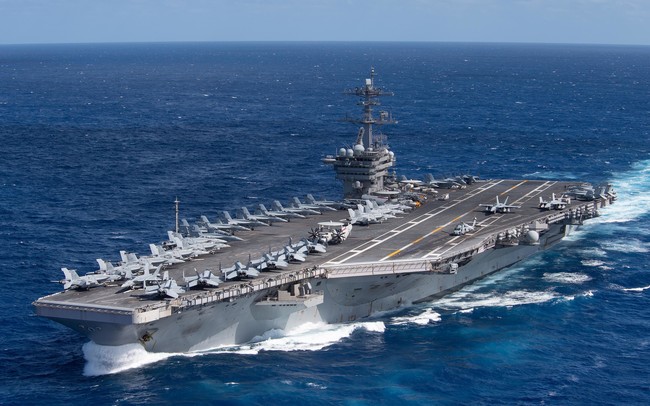
Third U.S. Carrier Arrives Near Iran Amid Stalled Talks
The USS Theodore Roosevelt entered the Middle East region on November 15, joining the USS George H.W. Bush and USS George Washington. Its arrival adds to a large U.S. naval presence as the conflict with Iran continues without a peace deal and negotiations have made little progress.
The Roosevelt operates with a carrier strike group that includes the guided-missile cruiser USS Chosin and its 11th Carrier Air Wing. Analysts estimated that 13 destroyers and a cruiser were deployed in the region. The Washington has remained there since arriving in August, while the Bush’s deployment has been extended.
U.S. forces have escorted commercial vessels through the Strait of Hormuz along a route near Oman. CENTCOM said more than 1.7 billion barrels of crude oil had passed through under U.S. protection. Iran’s Revolutionary Guard said on November 16 that two tankers struck mines while transiting under U.S. military guidance. UKMTO said it had received information about a tanker hit by an unknown projectile, causing an engine-room fire; no casualties were reported.
Explosions and surface-to-air missile fire were said to have occurred on Qeshm Island, but the claims had not been confirmed. Iran has also claimed attacks on U.S. radar installations in Bahrain; the U.S. military said drones launched toward Bahrain were intercepted without damage or injuries.
President Donald Trump has said he wants to resolve the conflict more civilly, and has reportedly considered avoiding new strikes if Iran and the Houthis do not launch further operations. Secretary of State Marco Rubio has said sanctions and the naval blockade are squeezing Iran without requiring U.S. strikes. The military buildup continues as Iranian Foreign Minister Abbas Araghchi is due to visit Muscat on November 17.
U.S. Adds Third Carrier as Iran Conflict Remains Unresolved
The arrival of the USS Theodore Roosevelt adds firepower to a U.S. force already concentrated near Iran, even as the conflict remains unresolved and no peace deal is in sight. The carrier joins the USS George H.W. Bush and USS George Washington, with other warships deployed in the region.
That buildup comes alongside a naval blockade and U.S. escorts for commercial shipping through the Strait of Hormuz. CENTCOM says more than 1.7 billion barrels of crude have passed through under U.S. protection. Yet the waterway remains dangerous: UKMTO received information that a tanker was struck by an unknown projectile, setting its engine room on fire. No casualties were reported. Iran’s Revolutionary Guard separately claimed two tankers hit mines while following U.S. military guidance.
The claims of explosions and missile fire on Qeshm Island remain unconfirmed. Iran has also claimed it targeted U.S. radar in Bahrain; the U.S. military says drones heading toward Bahrain were shot down without damage or injuries.
President Donald Trump has reportedly weighed holding off on fresh attacks if Iran and the Houthis do not launch new operations. Rubio has argued sanctions and the blockade can squeeze Iran without strikes. But with talks stalled and the military presence growing, restraint alone has not resolved the crisis or secured a lasting settlement. Araghchi is due in Muscat on November 17.
Trump Keeps Iran Options Open as Third Carrier Joins Region
The arrival of the USS Theodore Roosevelt gives the United States another carrier in the Middle East, adding to a substantial force near Iran while President Donald Trump weighs whether to order further attacks. The Roosevelt joins the USS George H.W. Bush and USS George Washington, alongside other warships.
Trump has publicly said he wants to resolve the conflict more civilly and has reportedly considered refraining from new bombardments if Iran and the Houthis do not launch further operations. Secretary of State Marco Rubio has said the United States does not need to strike Iran while economic penalties and a maritime cordon are putting pressure on the country. The growing deployment leaves military options available while that pressure continues.
The Strait of Hormuz remains a central flashpoint. CENTCOM says more than 1.7 billion barrels of crude have been shipped through under U.S. protection. UKMTO received information that a tanker was struck by an unknown projectile, causing an engine-room fire, with no casualties reported. Iran’s Revolutionary Guard claimed two tankers hit mines while moving under U.S. military guidance.
Iran’s claims of attacks on U.S. radar in Bahrain were disputed by the U.S. military, which said drones were shot down without injury or damage. Explosions and missile fire were also said to have occurred on Qeshm Island, but those claims remained unconfirmed. With negotiations stalled and Araghchi due in Muscat on November 17, the administration faces a choice between continued pressure and another round of strikes.
Reported by PJ Media, Newsweek.





