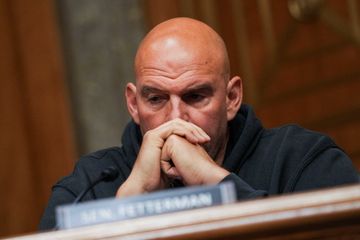
What Fetterman said about Van Hollen has Democrats reacting

Fetterman Van Hollen: John Fetterman says a Chris Van Hollen victory in the Senate Democratic leadership contest could push him toward leaving the party. But the Pennsylvania senator stopped short of saying he would go. His comments came amid two fights: a leadership challenge to Chuck Schumer and a sharper Democratic dispute over Israel and the war involving Iran.
In a Fox News interview on November 14, host Kayleigh McEnany asked Fetterman whether a shift further left by his party could cross a “red line.” He answered that it could, calling a Van Hollen-led caucus “troubling.” Fetterman believes the Maryland senator has built a reputation for hostility toward Israel. He argued that Democrats should direct more criticism at Iran, Hezbollah and Hamas. Asked again whether Van Hollen’s election would make him leave, Fetterman was less definite. He said he did not know what that would look like, while adding that he remained a Democrat. The Fox News interview captured the exchange.
That qualification matters. The exchange was a warning about a possible break, not an announcement of one. And although one report framed the prospect as a move to the Republican Party, Fetterman did not say in the interview that he had decided to become a Republican. He also appealed for bipartisan work. He named the national debt, artificial intelligence, Iran and Social Security as subjects on which he hoped Democrats could cooperate with the White House. At the same time, he said he saw little prospect of common ground with the party’s left over Israel.
Van Hollen announced his challenge to Schumer on November 12, two days before Fetterman’s televised remarks. He said the election had delivered a call to address an economy he described as rigged against working people and shaped by political corruption. He argued that meeting that demand required new leadership. Van Hollen has also urged Democrats to reconsider the Senate filibuster, which he calls antidemocratic. His position puts the rule itself into the leadership debate. Changing it could make it easier for a Senate majority to pass legislation, while also stripping the minority of a tool to block bills.
Schumer has led Senate Democrats for almost ten years and faces criticism from within his caucus after the midterm elections. The reports describe Democratic gains in both chambers and a growing appetite among some members for a change at the top. Senator Richard Blumenthal has called for new energy and ideas. Senators-elect Adam Hamilton and Troy Jackson have indicated they will not back Schumer. Progressive lawmakers, including Bernie Sanders and senator-elect Abdul El-Sayed, have backed Van Hollen. El-Sayed praised Van Hollen’s decision to travel to El Salvador to visit Kilmar Abrego Garcia, who was deported by the Trump administration. Van Hollen’s challenge to Schumer has therefore become a test of more than personal leadership. It touches the party’s approach to its new majority and the use of Senate rules.
Fetterman’s objections are tied most explicitly to Israel, but he also criticized Van Hollen’s profile as a progressive and questioned whether he has a viable path to the leadership post. The dispute sits within a broader divide that has left Fetterman politically isolated from many Democrats. He has maintained strong support for Israel and taken a hawkish position on Iran. Meanwhile, progressives have increasingly criticized Israeli government policy and U.S. support for it. Fetterman said Iran is an enemy committed to destroying Israel and the United States. Those are his characterizations, not a finding established by the reports. His appeal for bipartisan cooperation sits uneasily beside the stark language he used about his own party.
The disagreement has already spilled into the 2028 Pennsylvania Senate race. Ahmed Moor, a Gaza-born Palestinian-American writer and activist, announced a Democratic primary challenge earlier in the week. Fetterman called Moor “pro-Hamas.” Moor’s campaign rejected that description. It said he condemns violence against civilians by anyone and supports an arms embargo and sanctions until Palestinians have equal rights. The campaign said it would oppose antisemitism and anti-Palestinian racism. It also argued that Fetterman does not accurately represent Pennsylvanians. That is a contested political accusation, not an established finding. The reported challenge to Fetterman makes the party’s argument over Israel a direct contest for voters as well as a dispute among senators.
Fetterman’s standing within his state is also sharply polarized in the polling cited by one report. A Quinnipiac University survey released in October found that 13 percent of Pennsylvania Democrats approved of his job performance, compared with 72 percent of Republicans. He has previously voted with Republicans to end a government shutdown and confirm Trump appointees. Donald Trump has said he would welcome Fetterman switching parties. Republican Sen. Mike Lee also publicly invited him to join the GOP after the interview. None of those gestures resolves what Fetterman will do. The poll does not by itself explain why voters hold their views.
The Senate Democrats’ leadership election is scheduled for early December and will be held behind closed doors. Until then, Schumer’s challenge and Fetterman’s warning remain political pressure points, not settled outcomes. Van Hollen’s supporters are presenting his bid as a response to the election and a demand for change. Fetterman is presenting it as a threat to his place in the caucus because of Israel policy. The two arguments reveal how a fight over who leads can become a fight over what the party is willing to say and do. Van Hollen’s position on the filibuster adds another consequential question to that contest.
For my part, a party’s leadership fight is most revealing when it forces members to say what they would actually leave over. Fetterman has named Israel policy, but he has not said he is leaving. The vote in December will settle the leadership question; it may not settle the argument inside the party.
Update, November 15, 2026: Fetterman has also described a wider set of breaks with Democrats, backing stronger border controls and opposing proposals to curb ICE operations, including a ban on agents wearing masks. He was the lone Senate Democrat against a measure limiting Trump’s war powers over Iran and has opposed efforts to restrict some arms transfers to Israel. In a May Washington Post opinion piece, he called himself a poor fit for the GOP while saying he still votes with Democrats in most cases. He has also said he sees no common ground with El-Sayed and other Israel critics, whose views he said have gained acceptance among Democrats.
Reported by Townhall, The Washington Examiner, Raw Story, The Daily Beast, Fox News, Newsweek, Breitbart, The Daily Wire, Daily Mail US, Daily Kos, 6abc Philadelphia.