European Leaders Meet in Dublin on Ukraine and Security
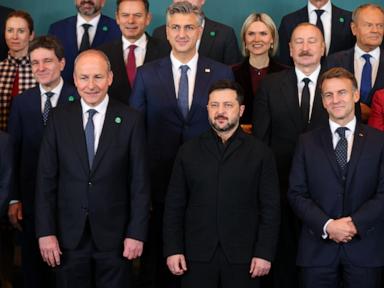
The European Political Community summit brings together leaders from inside and outside the European Union as a U.S.-backed effort to restart negotiations on the Russia-Ukraine war gets under way. Ukrainian President Volodymyr Zelenskyy arrived in Dublin on November 11. U.S. representatives Steve Witkoff and Jared Kushner are set to hold talks with him after meeting Russian President Vladimir Putin in Moscow on November 12.
The gathering also comes after a series of disruptions across Europe, including hoax bomb threats to airlines and media organizations, reported cyberattacks on supermarket refrigeration systems and French blood banks, and drone and missile incursions into European airspace. Authorities have not formally assigned blame for the bomb threats. European officials have described a broader increase in hybrid threats, which can include cyberattacks, sabotage and other activity below the threshold of open conflict.
Irish Prime Minister Micheál Martin said the forum gives European leaders a place to work on shared security, stability and prosperity challenges. The group was created in 2022 after Russia’s full-scale invasion of Ukraine and includes countries beyond the EU. Its meetings do not produce binding decisions or formal declarations, and critics have questioned whether it has meaningful influence.
Ukraine is expected to be a central topic, alongside the security risks facing the wider continent. European Commission President Ursula von der Leyen has called for stronger EU coordination against hybrid threats and proposed developing a European Security Council. A former British defense attaché said gaps between countries could be exploited by Russia.
The Irish government described the summit as the largest international leaders’ gathering in the country and said it would involve the biggest security operation in the history of Ireland’s national police force. The European Council is due to meet on November 13.
Europe Needs a United Front Against Russia’s Hybrid Threats
Europe’s security cannot be treated as a series of isolated national problems. Leaders from more than 40 countries are meeting in Dublin on November 12 as Ukraine faces an uncertain path to peace and European governments confront bomb hoaxes, cyberattacks and incursions into national airspace.
Ukrainian President Volodymyr Zelenskyy is at the summit after U.S.-brokered negotiations began in the United Arab Emirates. U.S. representatives Steve Witkoff and Jared Kushner are set to hold talks with him after meeting Russian President Vladimir Putin. The war remains central to the discussions, alongside concern about activity attributed by some officials to Russia and Iran. Authorities have not formally blamed a state or organization for the recent bomb threats.
The stakes extend beyond Ukraine. European Commission President Ursula von der Leyen has argued that the EU needs better tools and coordination to counter hybrid threats, including sabotage, cyberattacks and drone incursions. A former British defense attaché warned that poor coordination leaves openings that Russia can exploit. The summit is a chance to address those gaps, even though the European Political Community cannot issue binding decisions.
Irish Prime Minister Micheál Martin said the gathering would address shared security, political and economic challenges. Its value will depend on whether governments can turn discussion into coordinated preparation, while supporting Ukraine through an uncertain negotiating process. The European Council is scheduled to meet on November 13.
Europe’s Security Summit Must Deliver More Than Another Forum
Europe’s leaders are gathering in Dublin on November 12 amid bomb hoaxes, cyber incidents and airspace incursions, yet the forum they are using cannot make binding decisions. The European Political Community brings together more than 40 countries, but critics say its meetings risk becoming a talking shop rather than a source of practical security measures.
The agenda includes the Russia-Ukraine war, as U.S.-backed negotiations resume. Ukrainian President Volodymyr Zelenskyy is in Dublin, while U.S. representatives Steve Witkoff and Jared Kushner are set to hold talks with him after meeting Russian President Vladimir Putin. European leaders must consider the consequences of those negotiations for Ukraine and the continent’s security.
They are also confronting a spate of hybrid threats, from hoax bomb warnings to cyberattacks and drone incursions. European officials have raised concerns about Russian and Iranian activity, but authorities have not formally assigned responsibility for the recent bomb threats. The risks are real; so is the need for clear coordination among national governments and existing security institutions.
European Commission President Ursula von der Leyen has proposed a European Security Council and a common approach to hybrid threats. A former British defense attaché said divisions between countries leave gaps that Russia can exploit. Dublin’s discussions should be judged by whether they help close those gaps, not by the size of the gathering. The European Council meets on November 13.
Reported by The Philadelphia Inquirer, Newsweek.