Veterans Day Ceremony Unfolds Amid Fight Over Arlington Arch

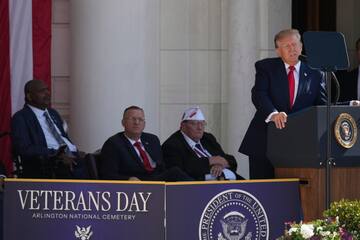
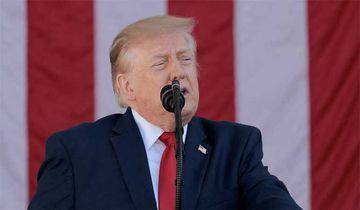
President Donald Trump marked Veterans Day at Arlington National Cemetery with a wreath-laying at the Tomb of the Unknown Soldier and remarks alongside Vice President JD Vance. First Lady Melania Trump joined the ceremony. The public observance honored fallen service members; the day’s political backdrop was a growing legal fight over the Trump Arlington arch, a proposed 250-foot structure near the cemetery entrance. The wreath-laying ceremony and the president’s remarks were reported as separate parts of the observance, while a later account said he also addressed the war with Iran, without supplying the substance of what he said.
The arch is planned for Memorial Circle, a roundabout on a historically important view corridor between the Lincoln Memorial and Arlington. The proposed structure would be 250 feet tall and 165 feet wide, topped by a large gold Lady Liberty statue. It would dwarf the Lincoln Memorial and stand about half the height of the Washington Monument, according to the reports. The corridor is described as linking monuments that commemorate the country’s reunification after the Civil War with the solemn setting of the cemetery. The project’s supporters present it as a tribute to national heroes; opponents argue that its scale and location would alter a place whose meaning depends partly on its setting.
The legal opposition has accumulated in stages. The initial case was brought in February by three Vietnam War veterans along with other private plaintiffs. On October 31, the District of Columbia and Virginia brought their own cases, which a federal judge consolidated that day. The litigation raises several distinct concerns: possible harm to a historic site, disruption to traffic, and the effect of the structure on the dignity and experience of people visiting graves. A judge last week barred the administration from breaking ground for 14 days. That temporary order does not decide the larger dispute, but it keeps construction from proceeding while the court considers the challenge.
Nine members of the Kennedy family entered the fight on November 10, asking to intervene in two existing lawsuits. The group includes descendants of Robert F. Kennedy and Edward M. Kennedy, both brothers of President John F. Kennedy. The three brothers are buried near one another at Arlington, close to the eternal flame at JFK’s gravesite. The relatives argue the arch would cast a shadow over family graves and permanently change the experience of visiting them. Their filing says the family would lose the ability to encounter the sites as it has in the past. Their claim is about the proposed structure’s effect on the graves and their surroundings; the reports do not say a court has accepted that argument as fact. Details of the Kennedy family’s effort to block the arch are now part of the wider case.
The White House disputes the political meaning of the lawsuit. A spokesperson said the arch is meant to honor those buried at Arlington and criticized the family members for joining the litigation, arguing that the courts should not become a vehicle for politicizing a project intended to unite the country. Robert F. Kennedy Jr., the health and human services secretary and a relative of the plaintiffs, did not join them. The reports describe his relationship with many family members as fractured, but do not offer a statement from him about the lawsuit. The contrast is plain: relatives say the design would harm the memorial setting; the administration says the project is an honor. The court must now assess the legal claims rather than settle the family’s differences.
This arch also belongs to a broader set of Trump projects reshaping federal spaces in Washington. The reports mention renovations at a public golf course and a threat to tear down the John F. Kennedy Center for the Performing Arts. The arch has its own dedicated presentation online, but that publicity has not ended the legal dispute. Separate challenges come from veterans, the District and Virginia, as well as the Kennedy relatives. The project’s approval process and the administration’s arch website sit alongside lawsuits that question whether the plan can proceed as proposed. No final ruling is reported, and the temporary ban on ground-breaking is limited to 14 days.
There is also a political timetable in the background. The midterm elections put Congress under Democratic control, and the reports say that this could bring intensified scrutiny to the president’s Washington projects. That is a prospect, not a ruling or a confirmed legislative action. For now, the immediate contest is in court: whether the plaintiffs can establish grounds to stop or alter construction, and whether the administration can advance the project after the temporary restriction expires. The reports leave open the questions of final approval, the arch’s eventual design and the outcome of the lawsuits.
For my part, the ceremony and the lawsuit make an uneasy pairing. Arlington is a place where the setting carries meaning, not merely a backdrop for a project. The court’s next steps matter because the dispute is about what may be built beside the graves, and how that place is meant to be experienced.
Update, November 11, 2026: At the ceremony, Trump said the nation would remember veterans’ service and sacrifices, and described fallen service members as looking down on those gathered. He recognized 103-year-old World War II veteran Cpl. Wilbur J. “Jack” Myers, retired Col. Frank Arthur Athanason, whose service included Korea and Vietnam, and retired Sgt. 1st Class Ryan Hendrickson, a former Green Beret wounded in Afghanistan. Second Lady Usha Vance and Veterans Affairs Secretary Doug Collins also took part in the observance; other officials present included Defense Secretary Pete Hegseth and Joint Chiefs Chairman Gen. Dan Caine.
Reported by The Daily Wire, The Washington Examiner, PBS NewsHour, MSNBC, FOX 5 DC, ABC News, The New Republic, CBS News, Breitbart, Newsweek.