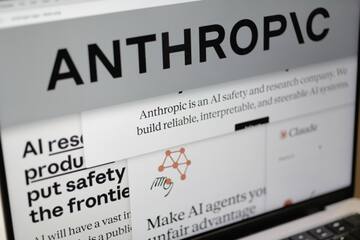
Anthropic’s Revenue Surges as Compute Costs and AI Risks Mount
Anthropic’s updated IPO filing showed revenue of $16.96 billion for the three months ended September 30, up from $11.56 billion in the prior quarter and $1.4 billion a year earlier. But quarterly growth slowed to about 47%, from roughly 144% in the second quarter, and price reductions and contractual discounts cut revenue by about $600 million between the quarters.
Higher costs pushed the company to a $567 million operating loss, compared with an operating gain of $974 million in the second quarter. Anthropic said short-term computing capacity costs significantly more than capacity secured through longer-term deals. Its adjusted operating margin fell to 15% from 19%. The $23.3 billion net loss was much larger, but mostly arose from a bookkeeping expense resulting from convertible notes becoming more valuable.
The company disclosed $895.4 billion in committed spending, largely for computing and infrastructure, with $70 billion due in the next 12 months. It had $146.6 billion in liquidity at the end of September. Anthropic filed its initial IPO paperwork last week and plans to list on Nasdaq under the ticker ANT.
The filing also said Anthropic’s internal estimates suggest it may soon meet its own definition of “dramatically accelerated progress attributable to AI.” The company said no current model has crossed that threshold. It warned that AI-assisted research could advance models faster than safety measures can be developed, and said it is considering policy changes to keep humans meaningfully involved in frontier-model development.
Anthropic’s AI Boom Raises Urgent Questions About Human Oversight
Anthropic’s IPO filing puts a crucial issue beside the company’s explosive growth: it says AI-assisted research may soon meet its definition of dramatically accelerated progress, while acknowledging that safety measures could fall behind. The company said no current model has crossed that threshold, but is considering changes to keep humans meaningfully involved in developing frontier systems.
That warning deserves attention as Anthropic scales. Revenue reached $16.96 billion in the third quarter, but a surge in costs produced a $567 million operating loss. The company’s adjusted operating margin fell from 19% to 15%, and it has committed $895.4 billion to computing and infrastructure. It also disclosed $70 billion in spending due over the next 12 months.
The filing shows why growth alone cannot settle the debate about AI’s future. Anthropic says its models may progress faster than it can validate and implement safety measures. That is a risk the company itself identifies, not a threshold its current models have already crossed. Its proposal to maintain meaningful human supervision is therefore central as it approaches an IPO and makes unprecedented infrastructure commitments.
Anthropic’s IPO Shows AI’s Promise—and the Cost of Overreach
Anthropic’s updated IPO filing captures both the scale of the AI opportunity and the danger of letting alarming projections outrun what the company has actually established. Revenue reached $16.96 billion in the third quarter, up from $1.4 billion a year earlier. Anthropic also said no current model has met its internal standard for sharply accelerated progress driven by AI.
The company’s growth is costly: it posted a $567 million operating loss as computing expenses rose, and its adjusted operating margin slipped to 15%. Anthropic has committed $895.4 billion to computing and infrastructure, with $70 billion due in the next 12 months. Those investments point to the vast capacity needed to build and operate advanced AI.
Anthropic’s own warning should be read precisely. It says internal estimates suggest the company may soon reach its threshold, and that AI-assisted research could outpace safety work. It also says it is considering policy changes to keep humans meaningfully involved. The filing does not say that current models have crossed the threshold or can independently build successive generations. As the company moves toward a Nasdaq listing, investors and the public will have to weigh real costs and risks against the promise of continued development.
Reported by Business Insider, New York Post, Fortune, The Philadelphia Inquirer, TechCrunch, Breitbart.