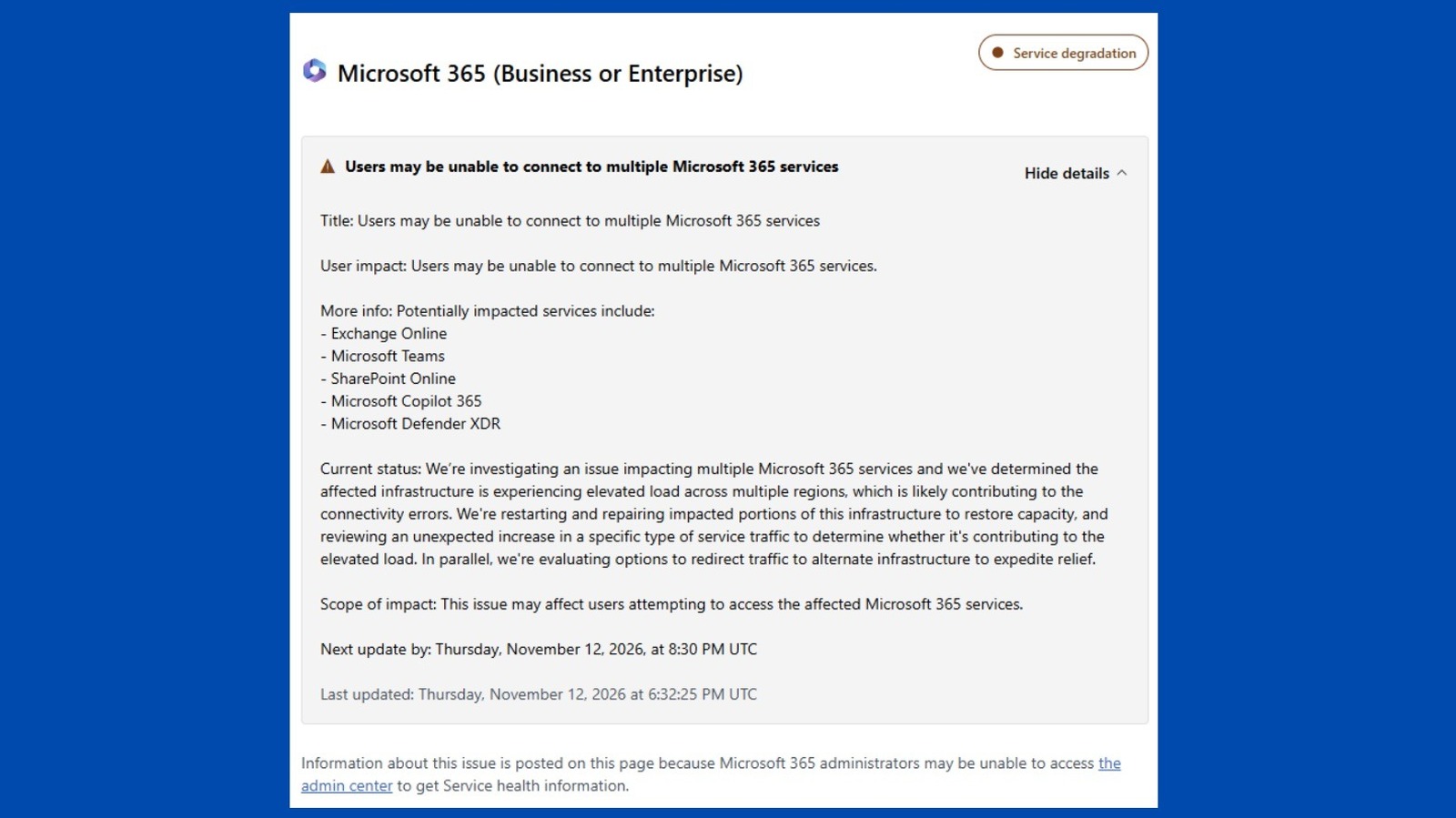
Microsoft explains what went wrong in its global outage
The Microsoft outage disrupted Outlook, Teams, Copilot and other Microsoft 365 services around the world, interrupting work for businesses, government staff, hospital employees, students and individuals. Microsoft apologized after the network failure. The outage began around midday Thursday, November 12, and Microsoft said Friday that services were broadly recovering. The company has not published a final count of affected users, identified the hardest-hit regions and products, or given the disruption’s exact duration. So the headline number remains uncertain: reports described millions of people affected, while another account referred to thousands unable to reach email and cloud tools. The scale was plainly substantial; the precise tally is not yet established. Reports on the outage describe the disruption across Microsoft’s services.
Microsoft’s explanation points to a technical failure, not a cyberattack or artificial intelligence. The company said an issue introduced during an earlier network-capacity upgrade surfaced after a more recent network change. It also said that several servers stopped operating, increasing pressure on the infrastructure still online. Microsoft said engineers had resolved the underlying cause, while still working to restore access for some customers and regions. These details describe a chain of events, not yet a complete technical account: the company has promised to release findings after its internal review, but has not said when they will appear. The company’s account of the capacity upgrade gives the central explanation available so far.
Recovery was gradual. Microsoft said it brought services back in stages, checking stability at each step because the scale of demand made a rapid restart risky. Earlier attempts exposed a wrinkle: some servers appeared healthy when they returned, then became unresponsive after traffic resumed. By Friday, mailbox access was improving in North America and delayed email was being processed, but users still reported intermittent trouble with Outlook, Copilot and other workplace tools. Microsoft extended the delivery window for messages caught in the backlog, giving them until at least Saturday afternoon to arrive before they could be marked undeliverable. The company’s argument is that a slower restoration helped avoid another unstable one. That is plausible; the promised review should show what checks were used and what remains to be fixed. The recovery’s effects in North America included delayed messages and uneven access.
The consequences reached beyond an inconvenient inbox. Hospitals in the United Kingdom reportedly turned temporarily to paper records, and pharmacies worried about filling prescriptions. In the United States, congressional staff said policy negotiations were derailed. Other users joked that the outage offered an unscheduled break from work, then lamented when services returned. Those are very different experiences of one failure: an early finish for some, a practical headache for others. The disruption also coincided with technical problems at OpenAI and Anthropic, companies that partner with Microsoft, though the reports do not establish that Microsoft’s outage caused those problems. The worldwide service disruption affected Outlook and Teams as well as other tools.
The episode has revived questions about how much routine activity depends on a small number of digital platforms. The comparison with the 2024 CrowdStrike-related outage is useful but not exact. In that case, a faulty security-software update crashed roughly 8.5 million Windows systems; it was described as historic in scale. The resulting disruption at Delta Air Lines lasted several days, with more than 7,000 flights canceled and over 1.3 million passengers affected. Those figures do not tell us what happened inside Microsoft’s network in November 2026. They do illustrate how a technical problem at one point in a complex system can spill into organizations that rely on it, and how recovery may take longer than fixing the original fault. The CrowdStrike outage record and Delta’s extended operational disruption offer context, not a claim that the incidents were identical.
Speculation filled the information gap before Microsoft’s explanation did. People online blamed artificial intelligence, a malicious intrusion, geopolitical intrigue, or even heavy game downloads. Microsoft rejected the cyber and AI explanations, saying its initial assessment found no malicious attack. The reports provide no evidence for the other theories either. Nor do they establish that recent workforce buyouts or cost-cutting caused the outage. Microsoft had offered buyouts to more than a quarter of its workforce, or 60,000 employees, while restructuring and investing in AI infrastructure; that timing prompted conjecture, not proof of a connection. The distinction matters. A company’s staffing choices can be questioned, but chronology alone does not diagnose a network failure.
What happens next is less dramatic than the online theories and more useful: Microsoft says it plans to release a detailed account of the incident after completing its review. That account could clarify the precise failure, the scale and duration of the impact, why servers failed under traffic, and whether alerting or recovery procedures worked as intended. A cybersecurity expert quoted in one report noted that Microsoft’s alert system appeared not to work, but the available reports do not establish the full scope of that problem. Until the review arrives, claims about a specific fix or a guaranteed safeguard would get ahead of the evidence. Microsoft’s account of failed server health checks is another relevant thread in the recovery questions.
For my part, I want the postmortem to be more than an apology with technical nouns attached. A phased recovery may have been the prudent choice, but customers deserve enough detail to judge that for themselves. The outage is a reminder that convenience can make dependence look invisible—until the email stops arriving.
Reported by WBUR, FOX 13 Seattle, FOX 10 Phoenix, New York Post, Deadline, CBS Chicago.