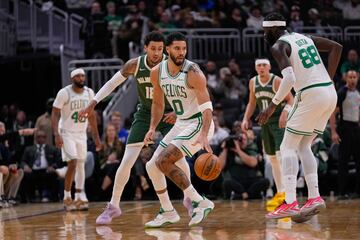
Boston’s comeback was built on Toronto’s cold streak

The Celtics Raptors comeback produced a 98-93 win over Toronto on November 11, extending Boston’s winning streak to five and offering a useful reminder that a comeback is not necessarily proof that every part of the winning team played well. The Celtics fell behind by 22, recovered, then needed late stops and free throws to finish the job. Jayson Tatum shot 6-for-21 from the field, yet his fourth-quarter decisions helped settle the outcome. The game report records the final score and the five straight wins; the fuller story is in how the shooting conditions changed.
Toronto opened with an eruption from beyond the arc. The Raptors made 10 of 18 threes in the first quarter, tying a franchise mark for threes in a period, and stretched their lead to 59-37 with 5:24 remaining in the second. Ja’Kobe Walter made four of five threes in that opening quarter, while Toronto’s early shot volume and accuracy looked nothing like its season profile. The Raptors’ team history places the club in the NBA’s Atlantic Division, but the relevant identity on this night was simpler: Toronto had found a hot hand early.
The counterintuitive part is that Boston did not need to shoot the lights out to erase the deficit. Tatum returned earlier than usual in the second quarter, then helped drive a 16-0 Boston run. A foul on his made three was upgraded to a flagrant foul, producing a free throw and retained possession; Baylor Scheierman then hit a three, making the sequence a seven-point trip. The Celtics turned a 22-point hole into a seven-point halftime deficit, and later briefly took the lead. The play-by-play account details that swing and Toronto’s extended drought from deep.
The scale of the reversal matters, but so does its cause. Toronto went from 10-for-18 from three in the first quarter to 6-for-25 over the rest of the game. Another review described the split as 12 makes in the first 20 attempts, followed by four in the next 23. Those are not identical ways of dividing the game, but they tell the same story: the Raptors’ exceptional start did not hold. Boston’s defense also improved, and Toronto’s turnovers gave the Celtics chances to convert. The box-score analysis notes that three turnovers before halftime became nine Boston points, with more points coming off turnovers after the break.
That is regression to the mean with a defensive component, not a guarantee that every early lead will evaporate. Toronto entered the game near the bottom of the league in three-point percentage and attempts, according to the game account, but a season profile does not prevent a team from having a spectacular quarter. It does make a hot opening a risky foundation for predicting the next three quarters. Boston still had to execute, particularly because it was missing Paul George, who sat with an illness, while Toronto played without Kawhi Leonard and Scottie Barnes. Leonard had missed nine straight games; Toronto said it would update his status in a week, and coach Darko Rajakovic described him as progressing with individual conditioning.
The Celtics’ own shooting offers a second warning against reading a box score too literally. Tatum finished with 24 points, seven rebounds and eight assists, but his poor field-goal percentage makes “dominant scoring night” the wrong description. His value arrived at specific moments: he helped stop the first-half slide, made a difficult jumper with 1:55 left to put Boston ahead, and drew a foul with 25.2 seconds remaining. Tatum converted twice at the stripe, putting Boston ahead 94-93. Toronto’s Jamal Shead missed an open three, Neemias Queta gathered the rebound after contesting a later attempt, and Boston made its own free throws. Sam Hauser then stole the inbound pass to close it out.
Derrick White’s contribution is another reason the score alone undersells the work. He scored 19 points, added seven assists and blocked four shots, including a second-quarter rejection that helped change the feel of the game. Queta scored 11 points and grabbed 13 rebounds; one account credited him with a plus-27 rating, while also noting a less effective stretch before his late defensive work. The postgame takeaways describe White’s defense and Tatum’s late plays, while also keeping the context in view: Toronto’s two leading forwards were unavailable. Boston’s comeback was resilient, but it came against a depleted opponent, not a full-strength test.
The closing minutes were less about momentum than possession quality. Toronto led 93-90 with 1:14 left, then failed to score again. Barrett briefly restored the Raptors’ lead with a runner and a dunk after a steal, but the Celtics answered through Queta, Tatum and the defense. That late sequence is the useful distinction between a memorable comeback and a sound forecast: Boston’s finish was earned, while Toronto’s first-quarter shooting was unlikely to remain that extreme. The Celtics have already been linked to a road-trip preview, a prior comeback against Milwaukee, and a look ahead to Philadelphia; this win adds a particularly sharp example of why game flow can change faster than the first-half score suggests.
For my part, the most revealing number is not the 22-point deficit but Toronto’s sharp falloff from three. That does not make Boston’s win automatic or diminish the late execution. It does make the comeback easier to explain than to mythologize. Boston hosts Dallas on Sunday, while Toronto visits Philadelphia Thursday.
Reported by The Philadelphia Inquirer, The Boston Globe, Sports Illustrated.